Research · AI & compute
Anthropic After the Bell: $244.6B of Cash, a $451.6B Bill to 2030, and 3.7B Shares Waiting at the Door
Greythorn Research | Published Nov 22, 2026 (SGT) | EDGAR re-checked Nov 22, 2026, ~14:10 SGT: no new Anthropic filings since the 424B4 | Prices as of the Nov 20, 2026 US close; company data from Anthropic's final prospectus (424B4, dated Nov 18, 2026) and its Nov 20 closing announcement
Key Insights
- The listing worked; the aftermarket hasn't, yet. ANT priced at $83 (range $70–78), opened at $111.50 and touched $115.10 on Nov 19, which was +39% at the high. Two sessions later it closed at $88.91, only +7% above the offer, after an intraday low of $83.05 on Nov 20, six cents above the IPO price (Yahoo Finance; Anthropic 424B4).
- Liquidity is not the binding constraint before 2030. Margin is. After the full greenshoe, pro forma cash and short-term investments are $244.6B (424B4). That is 3.5x the $70.7B of commitments due in the 12 months after Sep 30, but only 54% of the $451.6B expected before end-2030 (our calculation). The real question is not whether Anthropic runs out of cash. It is whether revenue grows fast enough that ~$106B a year of compute does not swallow the income statement.
- Supply is the near-term overhang. 3.7B shares under the 180-day lock-up can be released early. That is 3.3x the 1.127B shares sold in the IPO (our calculation). Releases started on day one, with up to 10% for employees, and the next contractual step falls on Dec 15. That is one day after Day 26, around Dec 14, when the 22 syndicate banks would conventionally start research coverage.
- The valuation still prices the ramp. At $88.91 the fully diluted equity value is about $1.63T and EV about $1.38T. That is 39x trailing revenue, 17x the ~$81B run-rate, and roughly 30% above OpenAI's reported $1.25T private mark (our calculations; OpenAI figure is anonymous-source reporting).
- Our view: we correct our Nov 15 call on year one: it is funded several times over. We do not change the thesis. The stock is a leveraged bet on 2027–2029 revenue, and the first public results (FY26) will also be the trigger for the largest unlock step. We give no target price.
Opening Remarks
On Nov 15 we argued that Anthropic's compute commitments dwarfed its raise (Greythorn, Nov 15). Pricing proved part of that wrong. The company sold more shares at a higher price than the range implied. With the underwriters' option exercised, it received about $91.6B of gross IPO proceeds, plus $26.0B from the concurrent Class N placement (Anthropic, Nov 20). Year one is no longer a question.
The market then delivered a harsher test than any roadshow. Anthropic listed in the week the Nasdaq fell 10%, its worst week since 2020, and NVIDIA fell 23% (CNBC, Nov 21). On Nov 20 Reuters reported, citing people familiar with the matter, that SEC enforcement staff are examining potential accounting issues at NVIDIA. The SEC declined to comment and NVIDIA did not immediately respond; this is unconfirmed (Reuters). This note updates the numbers with the final prospectus and asks what has changed.
Background: What the Final Documents Say
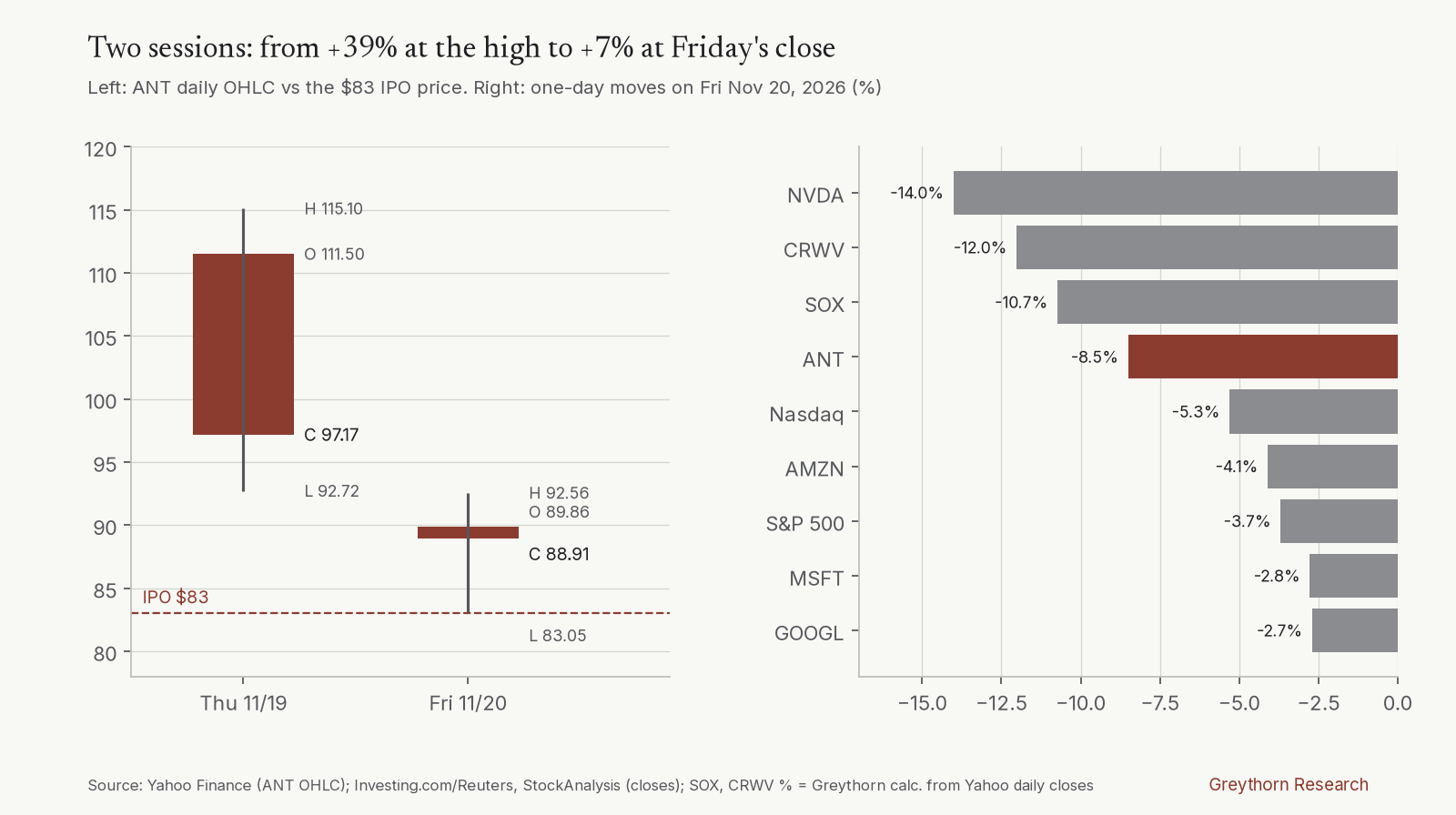
Source: Yahoo Finance (ANT OHLC); Investing.com/Reuters, StockAnalysis (closes); SOX and CRWV % = Greythorn calc. from Yahoo daily closes
- Final terms. 1,127,000,000 Class A shares at $83, including the full 147M-share option. 1,103,351,354 were new and 23,648,646 came from selling holders. Gross offering proceeds were ~$93.5B, of which ~$91.6B went to Anthropic (Anthropic). With the $26.0B placement, gross proceeds total ~$119.5B.
- Net proceeds. The 424B4 estimates $117.0B net with the option exercised, IPO plus placement, after underwriting fees on the Class A shares only (424B4).
- Shares. 13,366,642,276 shares are outstanding after the IPO, placement and option. The 424B4's fully adjusted share table adds options (treasury method), RSUs, Amazon's rollover notes, donation-matching shares and the Public Benefit Fund issuance. On that basis, plus the option, we count ~18.28B fully diluted shares.
- Placement buyers. Google and NVIDIA bought 120,481,927 shares each (~$10.0B each), and AMD bought 30,120,481 (~$2.5B). Broadcom, Micron, Microsoft and TSMC Partners took the rest. These Class N shares are not locked up but are "restricted securities" (424B4).
- Stabilization is gone. Morgan Stanley exercised the full greenshoe after day one, so the option can no longer be used to buy stock in the market below $83 (Reuters via Investing.com). Berenberg's Carsten Hesse called it positive for the company but "less positive for investors."
- Trading. Day-one volume was ~857M shares, 76% of the IPO share count. Day two was ~400M (Yahoo; our ratio). Reuters cites Vanda Research: retail traded ~$772M of ANT on day one, the most for an IPO debut since 2012. Listed options are set to start this week (Reuters via Investing.com).
Product and Technology
Anthropic sells the Claude model family through its own API and apps (Claude, Claude Code, Claude Cowork) and through AWS, Google Cloud and Azure. The 424B4 frames the products as "Virtual Collaborators." Claude Code is the flagship: in Q3, Claude Enterprise users who did not use Claude Code spent under $75 a month on average, while the top 5% who did spent about 20 times that. Cowork extends the same agent design to non-developers (424B4).
Three claims matter for investors, all from the 424B4:
- Compute is pooled across four chip families: AWS Trainium, Google TPUs, NVIDIA GPUs and AMD GPUs. That reduces dependence on any one supplier, including NVIDIA.
- Efficiency is improving fast. Q3 revenue grew 1,127% year on year, while compute and infrastructure expense grew 382%. Revenue per dollar of compute was $1.72 in Q3, against $0.68 a year earlier (our calculation from the quarterly table; CNBC quotes the same figures).
- Price is falling. Opus 5.5 cut customer cost per task by ~40% versus Opus 5. Price reductions offset ~$600M of revenue between Q2 and Q3.
The challenge: falling prices mean volume has to grow faster than price falls just to keep revenue growing. So far it has. Q3 is one data point after a price cut, not a trend.
Business Model and Financials
Revenue is mostly consumption-based and, in the filing's words, much of it "is not subject to long-term contractual commitments." CSP marketplaces carried 44% of nine-month revenue and 52% of receivables at Sep 30 (424B4).
| US$ | Q3'25 | Q4'25 | Q1'26 | Q2'26 | Q3'26 |
|---|---|---|---|---|---|
| Revenue | 1.38B | 2.04B | 4.73B | 11.56B | 16.96B |
| Compute & infrastructure | 2.05B | 2.95B | 3.39B | 5.56B | 9.86B |
| Compute as % of revenue | 148% | 144% | 72% | 48% | 58% |
| Operating income (loss) | (3.09B) | (2.84B) | (1.67B) | 0.97B | (0.57B) |
| Interest income | 0.12B | 0.19B | 0.35B | 0.76B | 1.25B |
Source: Anthropic 424B4, quarterly consolidated statements of operations (unaudited). Ratios are Greythorn calculations.
- Scale. Nine-month revenue was $33.2B. Trailing-twelve-month revenue is ~$35.3B, and Q3 annualized is $67.8B. The run-rate metric was ~$81B at Oct 31, up $10B in a month. The company defines run-rate as 28 days of consumption ×13 plus subscriptions ×12, and warns its operating metrics "have not been independently verified" (424B4).
- Cash. Nine-month operating cash flow was +$6.6B. GAAP net losses are dominated by fair-value charges on convertibles and SAFEs: $21.9B in Q3 alone. Those disappear as the notes convert.
- Customers. More than 11,900 customers spent ≥$100K over the trailing twelve months, up from more than 950 a year earlier. More than 1,900 spent ≥$1M and ~250 spent ≥$10M. Net revenue retention is ~900% (424B4).
- What changes after the IPO. Stock compensation steps up. The 424B4's pro forma includes a $14.7B stock-comp charge for RSUs modified at the IPO price and another ~$3.7B over ~3.8 years for 47M post-September RSUs. Expect GAAP operating losses in the IPO quarter.
Valuation at the Nov 20 close (Greythorn calculations):
| At | $83 (IPO) | $97.17 (11/19 close) | $88.91 (11/20 close) |
|---|---|---|---|
| Basic market cap (13.37B sh) | $1.11T | $1.30T | $1.19T |
| Fully diluted value (18.28B sh) | $1.52T | $1.78T | $1.63T |
| EV (FD − $244.6B cash) | $1.27T | $1.53T | $1.38T |
| EV / TTM revenue ($35.3B) | 36.1x | 43.4x | 39.1x |
| EV / Q3 × 4 ($67.8B) | 18.8x | 22.6x | 20.4x |
| EV / run-rate (~$81B) | 15.7x | 18.9x | 17.1x |
Our numbers match the press: CNBC's ~$1.6T fully diluted and Reuters' ~$1.2T basic and "about 40 times" trailing sales (CNBC; Reuters via Investing.com). The $109.7B carrying value of convertible notes is excluded from EV because the rollover notes are already counted as shares. Principal debt was $6.2B at Sep 30 (424B4).
Charts: Funding and Supply
1) Can the cash plus operating cash flow fund ~$106B a year?
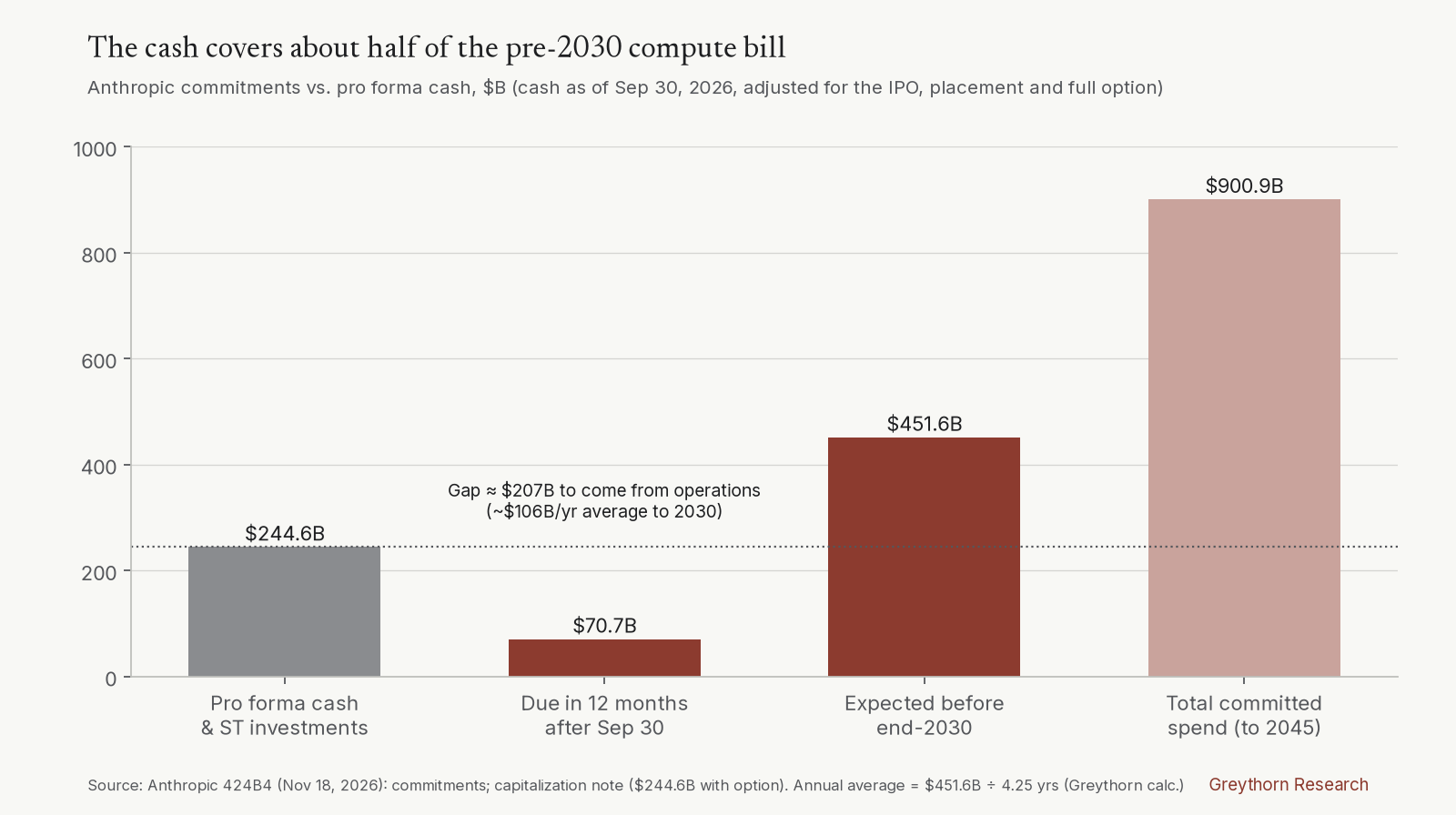
Source: Anthropic 424B4 (Nov 18, 2026). Annual average = $451.6B ÷ 4.25 years from Oct 2026 (Greythorn calc.)
Anthropic has signed $900.9B of committed spend, "substantially all" compute and infrastructure. $451.6B of it is expected before Dec 31, 2030 and $70.7B in the 12 months after Sep 30. Two lines in the same section cut both ways (424B4):
- Excluded. The total leaves out arrangements with no fixed dollar commitment, which the company estimates at $150–175B.
- Conditional. About $186.2B is subject to exercisable termination rights or conditions before commencement, such as a counterparty securing financing or facilities.
Our stress test, which is illustrative and not a forecast:
- Flat revenue. Revenue stays at the $81B run-rate. Compute averages $106B a year. Other cash operating costs run at ~$22.6B a year, which is Q3's non-compute opex of $7.66B less the $2.0B non-cash donation charge, annualized. The annual burn is then ~$48B, and $244.6B lasts about five years, into 2031, before interest income. But that leaves almost nothing for the ~$449B scheduled for 2031–2045. Anthropic does not need revenue growth to survive to 2030. It needs it to earn a return on the bill.
- Margin parity. To keep compute at Q3's 58% of revenue, $106B a year of compute implies ~$183B of average annual revenue for 2027–2030. That is 2.3x today's run-rate.
- Sell-side view. Citizens JMP forecasts $137.0B of revenue in 2027 and $417.8B in 2029 (CNBC). That clears the bar easily. It is one broker's forecast, not a consensus.
Nine-month operating cash flow of $6.6B is not what funds this. It is what remains after today's compute bill. The answer to the question is: yes for liquidity, conditionally for value.
2) What does the lock-up mean for supply?
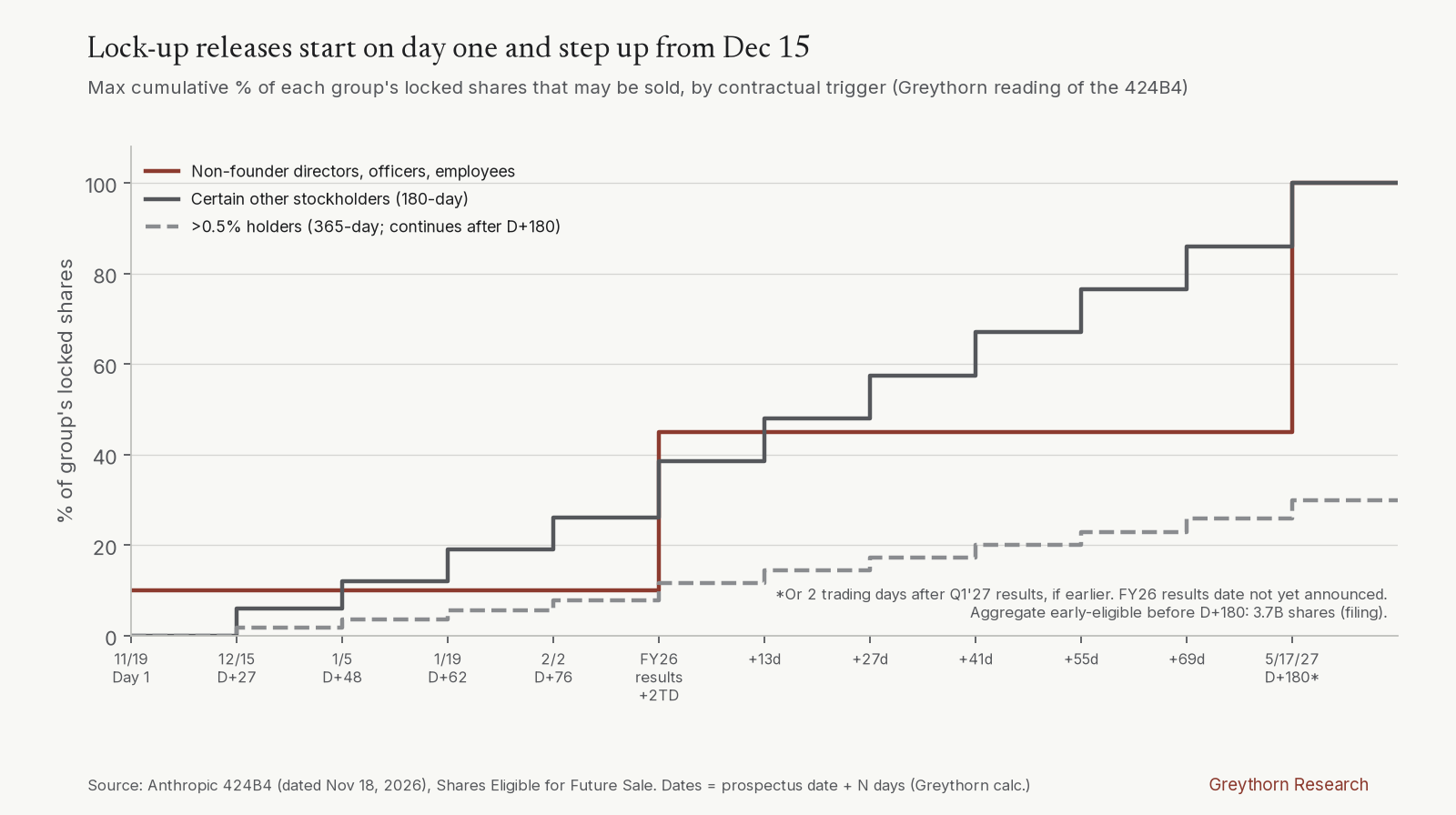
Source: Anthropic 424B4, "Shares Eligible for Future Sale". Percentages are maxima per trigger; cumulative steps are Greythorn's reading
About 15.5B shares (as-converted) are under lock-up or market-standoff agreements. The 424B4 sets several schedules:
- Non-founder directors, officers and employees. Up to 10% can be sold from day one, a further 35% two trading days after FY26 results, and the rest at the earlier of day 180 (May 17, 2027) or two trading days after Q1'27 results.
- Certain other holders (180-day). Up to 6% on each of days 27 and 48 (Dec 15 and Jan 5), 7% on each of days 62 and 76 (Jan 19, Feb 2), 12.5% after FY26 results, then 9.5% at each of five later steps.
- Holders of more than 0.5%, and the co-founders. These run to 365 days (Nov 18, 2027) or the Q3'27 results, with smaller early steps. Each founder group can sell up to 29% from day 180, or from Q1'27 results if earlier.
- Class N placement shares. Not locked up, but restricted. Google's registration-rights demand cannot force a public filing before the earlier of day 180 or Q1'27 results.
The filing caps the early-eligible total at 3.7B shares. That compares with a 1.127B-share IPO float. Reuters cites Intropic's estimate that index funds could buy up to 30% of the shares by year-end. That is a real offset, but it is an estimate, and it arrives in the same weeks as the December release steps.
Competition
The filing names Google and OpenAI as primary competitors, plus open-weight models (424B4). The comparison investors now have:
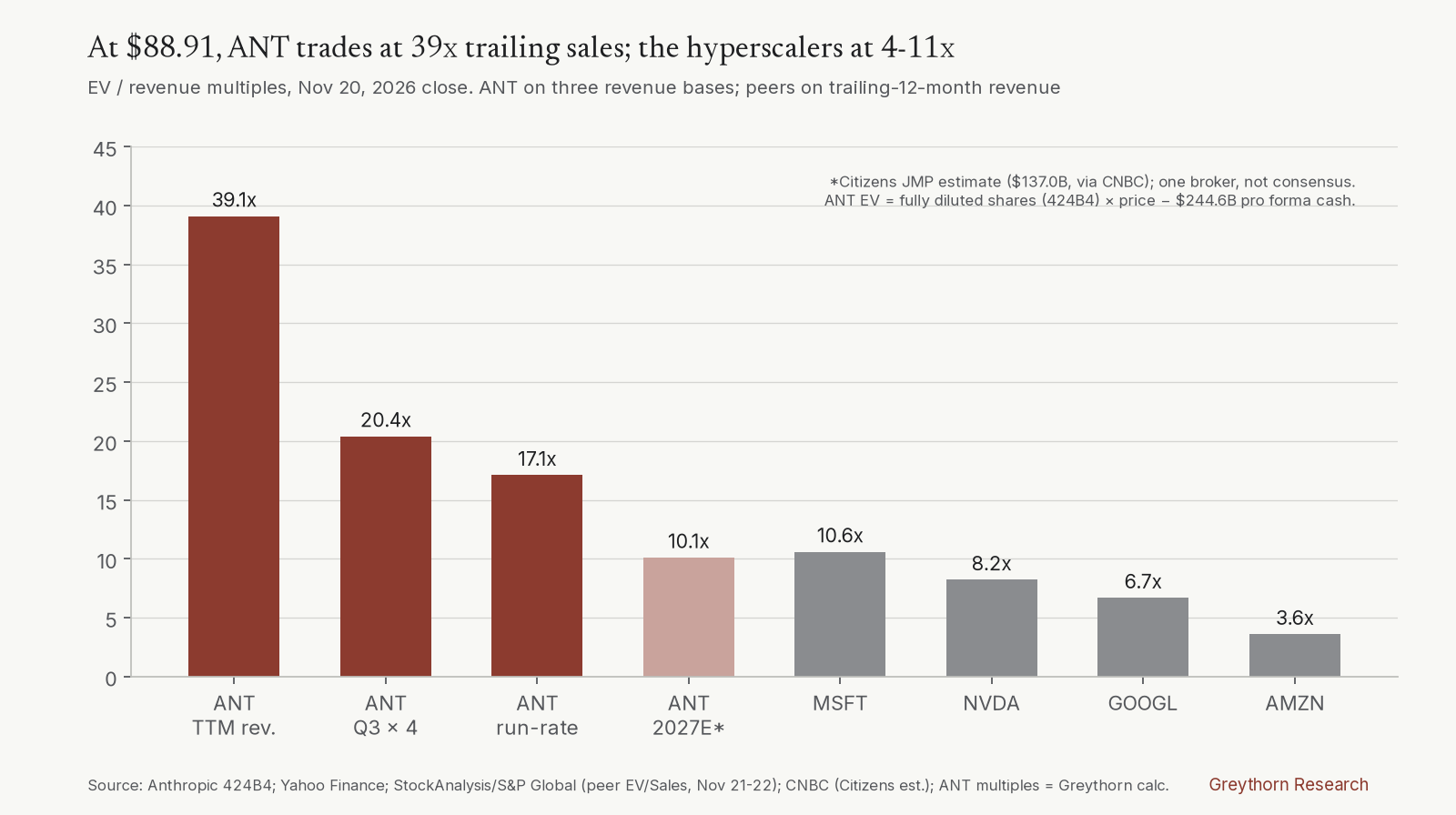
Source: Anthropic 424B4; Yahoo Finance; StockAnalysis/S&P Global (peer EV/Sales); CNBC (Citizens JMP estimate); ANT multiples = Greythorn calc.
- Public peers. On trailing revenue, Microsoft trades at 10.6x EV/sales, NVIDIA at 8.2x, Alphabet at 6.7x and Amazon at 3.6x (StockAnalysis/S&P Global, data to Nov 21–22). ANT trades at 39x trailing and 17x run-rate. Microsoft runs a 47% operating margin; Anthropic's Q3 GAAP margin was −3%. Only on a single broker's 2027 estimate (10.1x) does ANT look like Microsoft today.
- OpenAI. Bloomberg reported, citing people familiar, that OpenAI closed ~$11B of a round at $1.25T (Bloomberg). MSCI secondary data put OpenAI at $1.17T and Anthropic at $1.54T on Nov 9 (MSCI/PM Insights). Public ANT at ~$1.63T fully diluted is ~6% above its own pre-IPO secondary mark and ~30% above OpenAI's primary mark (our calculation). We could not verify OpenAI's current revenue from a primary source, so we do not compare multiples.
- Frenemies. Amazon and Google hold 1.94B and 1.77B Class N shares (14.6% and 13.4% of capital stock, per the 424B4). At $88.91 those stakes are worth ~$172B and ~$158B, about 6.4% of Amazon's and 4.8% of Alphabet's market caps (our calculation). They are investors, suppliers, distribution channels and, in Google's case, a direct competitor.
Risks (read these first)
- Take-or-pay against pay-as-you-go. Costs are contracted for years; revenue is mostly usage-based and repriced with every model release. The filing's own line is: "In the past, we have significantly underestimated our compute requirements."
- The AI-infrastructure selloff. ANT fell 8.5% on Nov 20, less than NVIDIA (−14.0%), SOX (−10.7%) and CoreWeave (−12.0%), but more than the Nasdaq (−5.3%). It is trading with the hardware complex, not as a refuge. The channels are threefold. First, the neocloud mid-layer (Lambda, Nscale) needs financing that is getting harder. Second, ballot measures that could slow data-center construction passed in the midterms (CNBC). Third, the supplier-shareholders are themselves under pressure, including NVIDIA (see the Reuters SEC report, unconfirmed).
- Supply and stabilization. 3.7B early-release shares, no greenshoe support, and options listing this week.
- Governance. A Class F share held by a founder LLC carries 50.1% of votes, and the Long-Term Benefit Trust elects a board majority. Class A holders cannot change control (424B4).
- Metrics risk. Run-rate and NRR are company-defined and unaudited. The filing says run-rate is sensitive to seasonality and model launches.
- Rates. A ~5% US 10-year raises the discount rate on cash flows that sit mostly after 2028.
Bull Case (steelmanned)
- Unit economics are already turning. Revenue per compute dollar went from $0.68 to $1.72 in a year, and nine-month operating cash flow is positive.
- The balance sheet buys time. $244.6B of cash funds even a flat-revenue scenario through 2030 on our rough math, which few listed AI-infrastructure names can claim.
- Flexibility is larger than headlines suggest. $186.2B of obligations carry termination rights or conditions. If the AI build-out slows, part of the bill shrinks with it.
- Analysts outside the syndicate are bullish. Eight non-syndicate firms have initiated: seven Buy or equivalent and one Hold. Five published targets range from $105 to $155, averaging $134 (StockAnalysis/TipRanks; Reuters via Investing.com).
- Index demand is coming. Intropic sees up to 30% of shares going to index funds by year-end (Reuters).
Bear Case
- 39x trailing sales with a negative GAAP margin. The price needs revenue to roughly double again before the multiple looks like Microsoft's today. What would prove it wrong: Q4 revenue at or above ~$20B with compute below 55% of revenue.
- A supply wall meets the first print. FY26 results trigger the largest employee release (+35%) and the start of five 9.5% steps for other holders. A soft first quarter would meet the most sellable stock. What would prove it wrong: a strong print absorbed without a drawdown.
- Price deflation outruns volume. The ~$600M Q3 price give-back could grow as Google and OpenAI compete on coding. What would prove it wrong: rising contracted revenue (RPO) in the first 10-K.
- Seaport's point stands. "An incredible leap of faith by investors" (CNBC).
What Would Change Our View
| Signal | Reassuring | Concerning |
|---|---|---|
| FY26 results (date TBA) | Q4 revenue ≥ ~$20B; compute < 55% of revenue | short-term compute keeps compressing margin |
| Syndicate initiations (~Dec 14) | targets well above $83 with commitments modeled | Holds or targets near the offer |
| Dec 15 / Jan 5 release steps | price holds above $83 | heavy volume breaks the offer price |
| Mid-layer financing | Lambda lease secured; Nscale financing closed | terminations of contingent capacity |
| NVIDIA / SEC | official statements that close the issue | confirmation of a formal action (currently unconfirmed reporting) |
Correcting the Record
- Our Nov 15 report said the commitments due within 12 months ($70.7B) exceeded what the IPO's new shares could raise ($62.5B at $78). Final terms reverse that: Anthropic received ~$91.6B gross from the IPO alone (Anthropic).
- Our Nov 15 report cited ~3.6B shares eligible for early sale (S-1/A-2). The final 424B4 says 3.7B.
- "Raised $81.3B" (CNBC, Nov 19–20) is 980M shares × $83, including selling holders' ~$2.0B. The closing figure with the option is $93.5B gross, of which $91.6B went to the company.
- The day-one high. Some outlets give $114.99. Yahoo's daily data shows $115.10. Either way the stock never reached $120.
Closing Remarks
The IPO answered the question we asked on Nov 15, whether the company can pay next year's bill, decisively. The two sessions since have asked a better one: what is a frontier-model company worth when the hardware complex it depends on is being repriced? At $1.38T EV the market is still paying for the 2027–2029 ramp. The cash removes bankruptcy from the bear case. It does not remove dilution, unlock supply or margin risk. We would rather see the first audited quarter and the December release steps than chase the first-week tape.
Main Sources
- Anthropic final prospectus (424B4), Nov 18, 2026
- Anthropic: closing of IPO and concurrent private placement, Nov 20, 2026
- Yahoo Finance: ANT historical prices
- Reuters via Investing.com: post-debut stumble, Nov 20 · stabilization position closed, Nov 20
- CNBC, Nov 21 · CNBC, Nov 20 · CNBC, Nov 19
- StockAnalysis/S&P Global peer statistics · ANT analyst ratings
- Bloomberg: OpenAI at $1.25T, Nov 6 · MSCI/PM Insights secondary marks
- Reuters: SEC probe of NVIDIA accounting, citing sources (unconfirmed), Nov 20
- Greythorn, Nov 15: Anthropic's $1.4 Trillion IPO
Disclaimer: This article is for research and information-sharing only. It is not investment, financial, legal or tax advice, and it is not a recommendation to buy, sell or hold any security. Data come from the public sources linked and are as of the dates shown; they may change. Calculations marked as ours are estimates based on those sources. The author or related parties may hold or trade assets mentioned. Readers should read the company's filings, do their own research and form their own judgment.
Follow our research on X at @0xGreythorn.
Greythorn Research