Research · AI & compute
Anthropic's $1.4 Trillion IPO: A $900.9B Compute Bill, Suppliers in the Cap Table, and What the Price Has to Assume
Greythorn Research | Published Nov 15, 2026 (SGT) | Data as of Anthropic's S-1/A-2 (filed Nov 10, 2026; financials to Sep 30, 2026) and an EDGAR check on Nov 15, 2026, ~20:50 SGT
Key Insights
- The terms have not moved. As of our Nov 15 EDGAR check there is no S-1/A-3, no range revision and no final prospectus. The latest filings are free-writing prospectuses dated Nov 10–12. The deal is still 825,000,000 Class A shares (801,351,354 new, 23,648,646 from selling holders) at $70–78, on Nasdaq as ANT. The company's own IPO website says pricing is expected Nov 18 and trading Nov 19, US Eastern time (S-1/A-2; IPO website FWP).
- The price is $1.02T or $1.41T, depending on how you count shares. At $78, the 13.07B shares the filing says will be outstanding are worth $1.02T. Add options, unvested RSUs and Amazon's unconverted notes and our fully diluted count is about 18.06B shares, or $1.41T. Net of roughly $216B of pro forma cash, that is an EV of about $1.19T: 17.6x Q3 revenue annualized and 33.8x trailing revenue (our calculation).
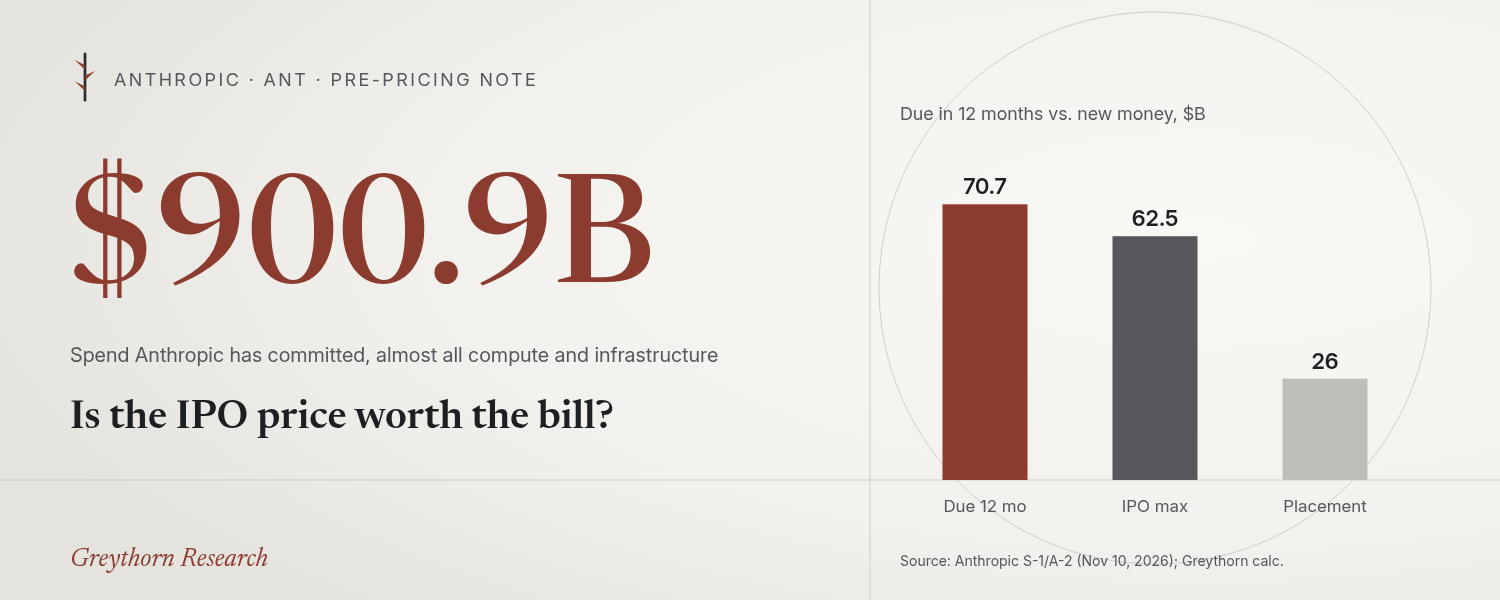
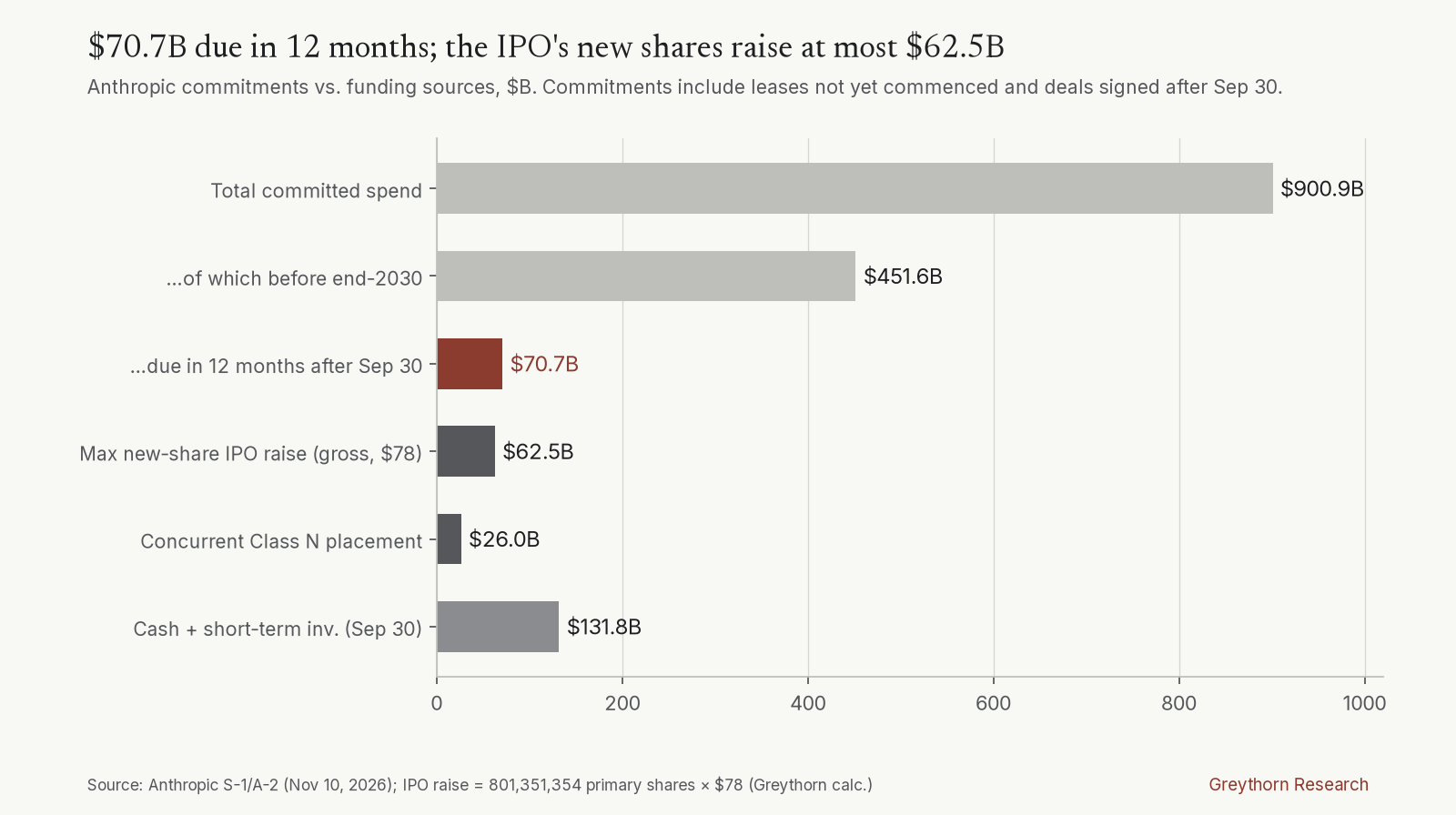
- The commitments dwarf the raise. Anthropic has signed $900.9B of committed spend, "substantially all" compute and infrastructure. $70.7B of it falls due in the 12 months after Sep 30, which is more than the $62.5B the new IPO shares can raise at the top of the range.
- The suppliers are buying the stock. $15.0B of the $26.0B concurrent placement comes from chip and memory suppliers (NVIDIA, AMD, Broadcom, Micron, TSMC). Google's $10.0B funds part of an investment it had already committed to. Anthropic's disclosed commitments to the same counterparties are roughly 8 to 160 times the size of their cheques (our calculation).
- Our view: the next 12 months are funded, and the business is real. Q3 revenue was $16.96B and nine-month operating cash flow was +$6.6B. But the price assumes the 2027–2030 ramp in compute costs, about $106B a year on average, is matched by revenue that is mostly consumption-based and not contracted. That is a bet, not a margin of safety. We give no target price.
Opening Remarks
Anthropic is about to attempt what Bloomberg says would be the largest stock-market debut on record, counting the placement (Quartz/Bloomberg). It is doing so during a week when the US 10-year yield rose 29.4bp to 5.152%, its biggest weekly gain since April 11, 2025 (Dow Jones/Tradeweb via Morningstar). Its $10B cornerstone investor NVIDIA has an interim CEO after Jensen Huang resigned on Nov 11 (NVIDIA 8-K).
The headline valuation has already come down. Anthropic raised at $965B in May and had been looking toward $2T until recently (CNBC). The range now implies up to $1.4T fully diluted. Demand is reportedly strong: about six times covered by Thursday, according to people familiar with the book (Reuters via CNBC TV18). That is anonymous-source reporting, not a filing.
CEO Dario Amodei put the central issue plainly at JPMorgan on Friday. "Compute is the deepest business dilemma that the company faces," he said (Bloomberg Tax). The company tends to "buy on the low side," wants to "underpromise and overdeliver," and is listing partly because "the more cash we have on hand, the more buffer we have" (Yahoo Finance). This note reads the S-1/A-2 to ask whether the price leaves room for that dilemma.
Background: How the Deal Is Built
- Timeline. Confidential draft Jun 1; public S-1 Oct 26; Amendment No. 1 Nov 2; Amendment No. 2 with the range Nov 10; FWPs for the IPO website, UK, Australia/Canada, EEA and Japan Nov 10–12 (EDGAR filing list).
- Offering. 801,351,354 primary and 23,648,646 secondary Class A shares at $70–78, plus a 123,750,000-share underwriter option. Goldman Sachs and Morgan Stanley lead (Anthropic). CNBC's sources say retail is targeted at about 20% of the deal.
- Concurrent placement. Google ~$10.0B, NVIDIA ~$10.0B, AMD ~$2.5B, Broadcom, Micron and Microsoft ~$1.0B each, and TSMC ~$0.5B buy $26.0B of non-voting Class N stock at the IPO price. That is 351,351,348 shares at the $74 midpoint. The placement is not subject to lock-up, though the shares are restricted securities (S-1/A-2).
- Proceeds. Net proceeds from the new shares and the placement are estimated at $84.6B at $74, or $93.7B with the option. Pro forma cash and short-term investments would be $212.7B (S-1/A-2, Capitalization).
- Control. A Class F share held by a founder LLC carries 50.1% of votes. The Long-Term Benefit Trust elects a majority of the board through a Class T share. Anthropic will be a Nasdaq "controlled company" (S-1/A-2).
Product and Technology
Anthropic sells Claude through its API, through the three major clouds' marketplaces, and as applications: Claude, Claude Code and Cowork. On Nov 9 it released two new frontier models, Claude Fable 5.2 and Claude Mythos 5.2 (CNBC). The IPO materials make three technical claims (IPO website FWP):
- More than 90% of contributions to Anthropic's codebase in September 2026 were written by Claude.
- "Compute efficiency" improved more than 4x from Q1 2025 to Q3 2026. The company defines this as revenue divided by compute expense, so it is a financial ratio, not a hardware benchmark.
- Compute is run as a "single, fungible pool" across AWS Trainium, Google TPUs, NVIDIA GPUs and AMD GPUs.
Pricing is falling as models improve. Opus 5.5 cut customer cost per task by about 40% versus Opus 5, and price reductions offset about $600M of Q3 revenue (S-1/A-2). Adoption is broad: more than 11,900 customers spent at least $100K over the trailing twelve months, up from more than 950 a year earlier. About 1,900 spent $1M+ and about 250 spent $10M+. Net revenue retention is about 900% (S-1/A-2).
Business Model and Financials
Consumption-based "pay-for-intelligence" revenue is "the substantial majority" of the total. Customers pay for usage metered in tokens, and "much of it is not subject to long-term contractual commitments" (S-1/A-2). In the first nine months of 2026, 44% of revenue came through CSP marketplaces, which also accounted for 52% of receivables at Sep 30.
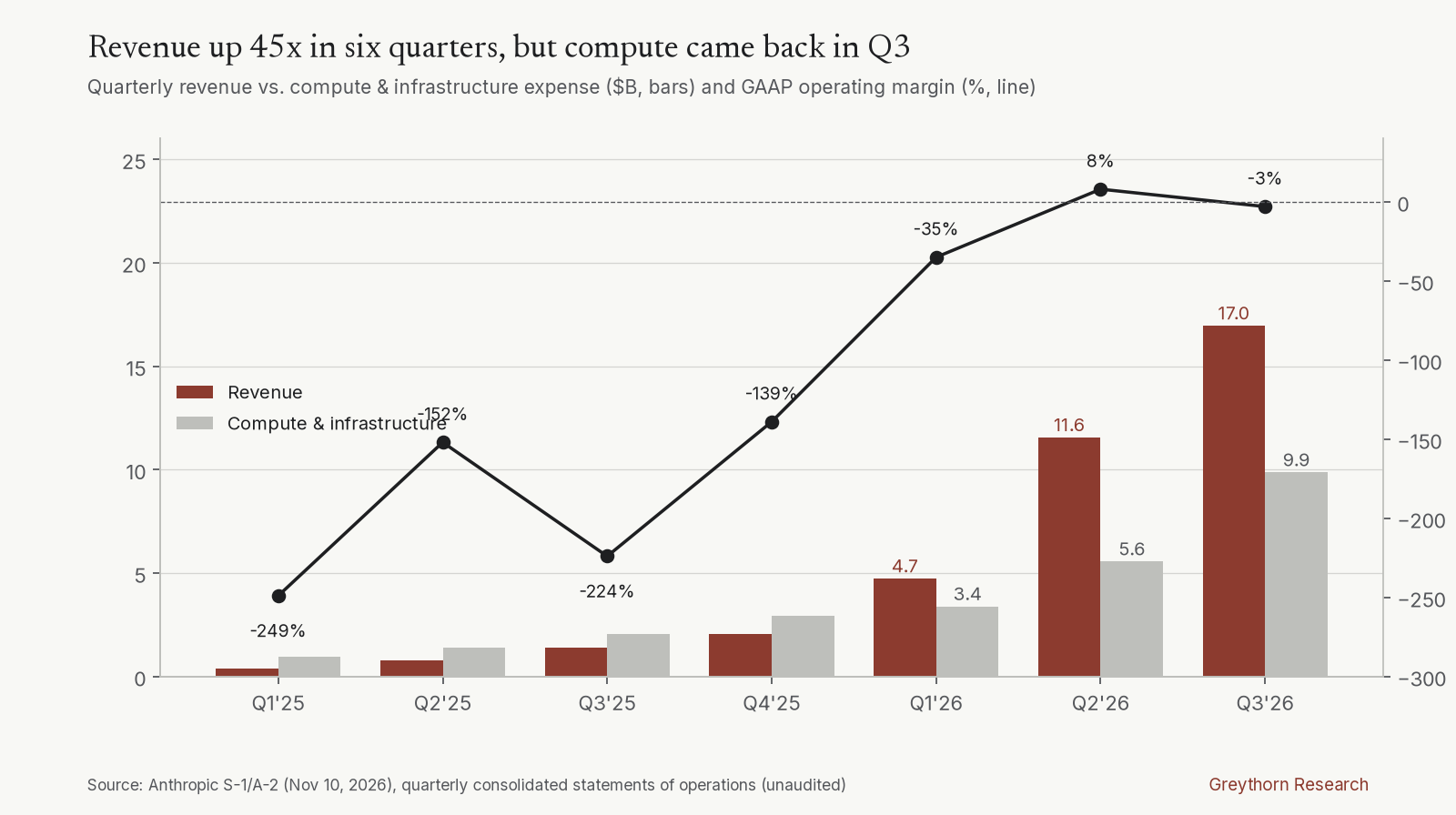
| US$ | Q3'25 | Q4'25 | Q1'26 | Q2'26 | Q3'26 |
|---|---|---|---|---|---|
| Revenue | 1.38B | 2.04B | 4.73B | 11.56B | 16.96B |
| Compute & infrastructure | 2.05B | 2.95B | 3.39B | 5.56B | 9.86B |
| Compute as % of revenue | 148% | 144% | 72% | 48% | 58% |
| Operating income (loss) | (3.09B) | (2.84B) | (1.67B) | 0.97B | (0.57B) |
| Net loss | (12.14B) | (16.86B) | (14.44B) | (66.31B) | (23.29B) |
Source: S-1/A-2, quarterly results (unaudited). Q3'25 includes the $1.5B Bartz settlement.
Source: Anthropic S-1/A-2, quarterly consolidated statements of operations (unaudited)
Three points stand out:
- Growth is slowing but still very fast. Revenue grew 47% quarter on quarter in Q3, after 144% in Q2 (our calculation). The company's run-rate revenue metric reached about $81B at Oct 31, up $10B in a month. That metric annualizes 28 days of usage, and the filing says it "is not a substitute for revenue."
- Q3 shows what happens when compute arrives early. The $567M operating loss reflects $5.0B of short-term compute, which "currently costs significantly more" than multi-year capacity, and a $2.0B non-cash donation-matching charge. The company reports an adjusted operating margin of 15% for Q3 (IPO website FWP).
- The GAAP net loss is mostly a valuation effect. Q3's $23.3B net loss includes a $21.9B fair-value charge on convertible notes, derivatives and SAFEs, which rises as Anthropic's valuation rises. Nine-month operating cash flow was +$6.6B. Q3 interest income of $1.25B exceeded the operating loss.
The Compute Bill
The $900.9B is not one contract. Our reconciliation of the filing's components:
- the $320.0B fixed contractual obligations table;
- $17.4B of short-term commitments;
- $451.2B of leases signed but not yet commenced;
- $105.7B of commitments signed after Sep 30;
- $6.6B of short-term deals signed after Sep 30.
That sums to $900.9B. It appears to exclude Google's estimated $125–150B of additional TPU compute and AMD's ">$20.0B" Helios tranche, which the filing describes as not having fixed dollar commitments.
Source: Anthropic S-1/A-2 (Nov 10, 2026). IPO raise = 801,351,354 new shares × $78 (Greythorn calc.)
The largest named arrangements (S-1/A-2):
- Google: at least ~$121.3B of CSP hosting through July 2033.
- Amazon: at least $110.0B through April 2036.
- SpaceXAI: up to $120.5B (NVIDIA GPUs), cancellable on 90 days' notice after initial non-cancellable periods ending in early 2027.
- Broadcom: ~$161.2B of equipment-lease rent for TPU capacity, non-cancellable.
- Microsoft: $47.2–49.2B.
- Nscale: up to ~$44.6B.
- Lambda: ~$41.3B.
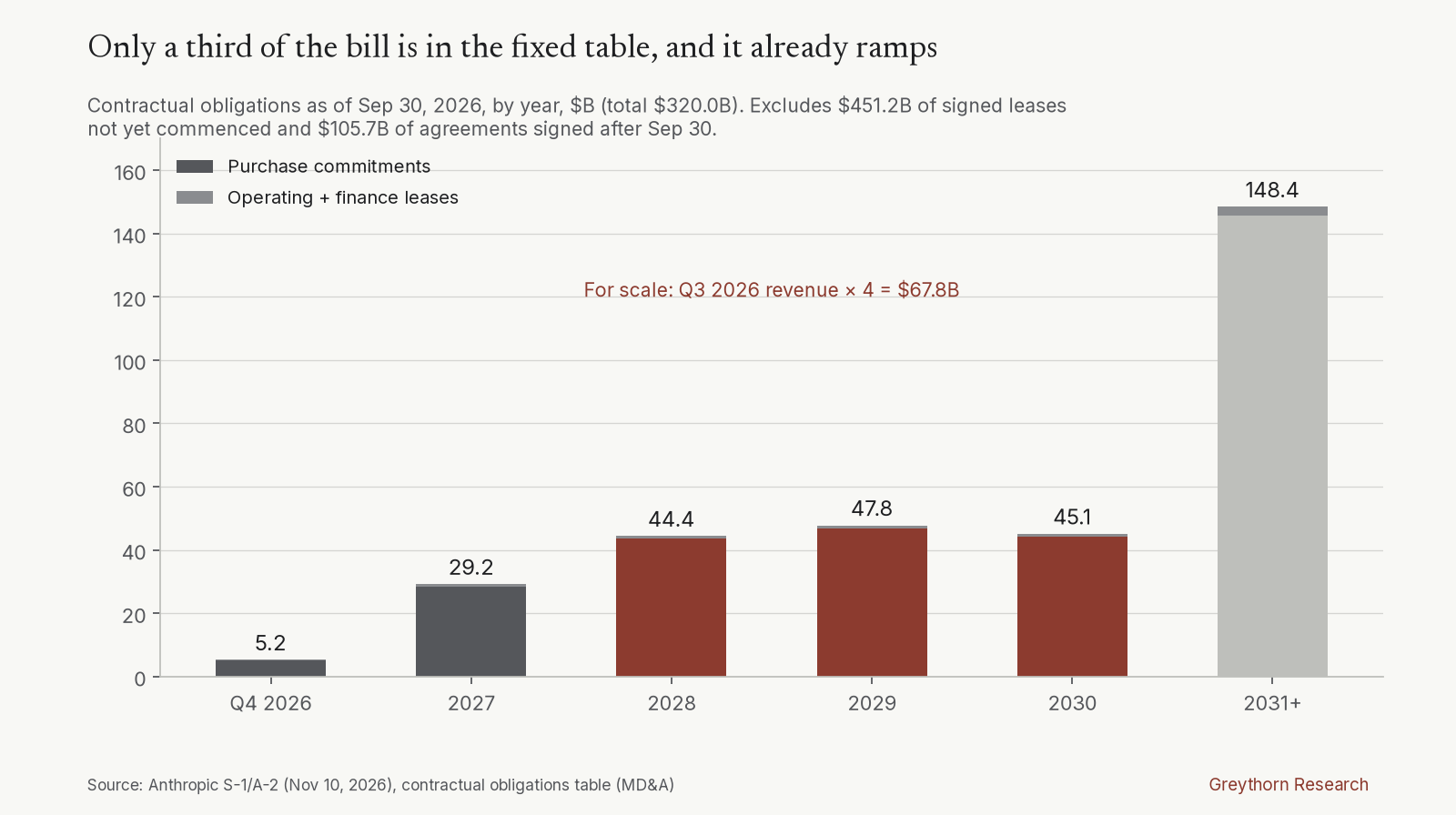
On liquidity, the 12-month number is not the problem. $70.7B is due against $131.8B of cash and short-term investments at Sep 30, before the IPO, and $4.2B of that $70.7B is subject to contingencies. The problem is the slope. The fixed table alone steps from $29.2B in 2027 to $44.4B in 2028 and $47.8B in 2029. The $451.6B the company expects to incur before end-2030 averages about $106B a year (our calculation). That compares with $67.8B for Q3 revenue annualized.
Source: Anthropic S-1/A-2, contractual obligations table (MD&A). Excludes leases not yet commenced and post-Sep 30 commitments.
Circular Vendor Financing: The Investors Are the Suppliers
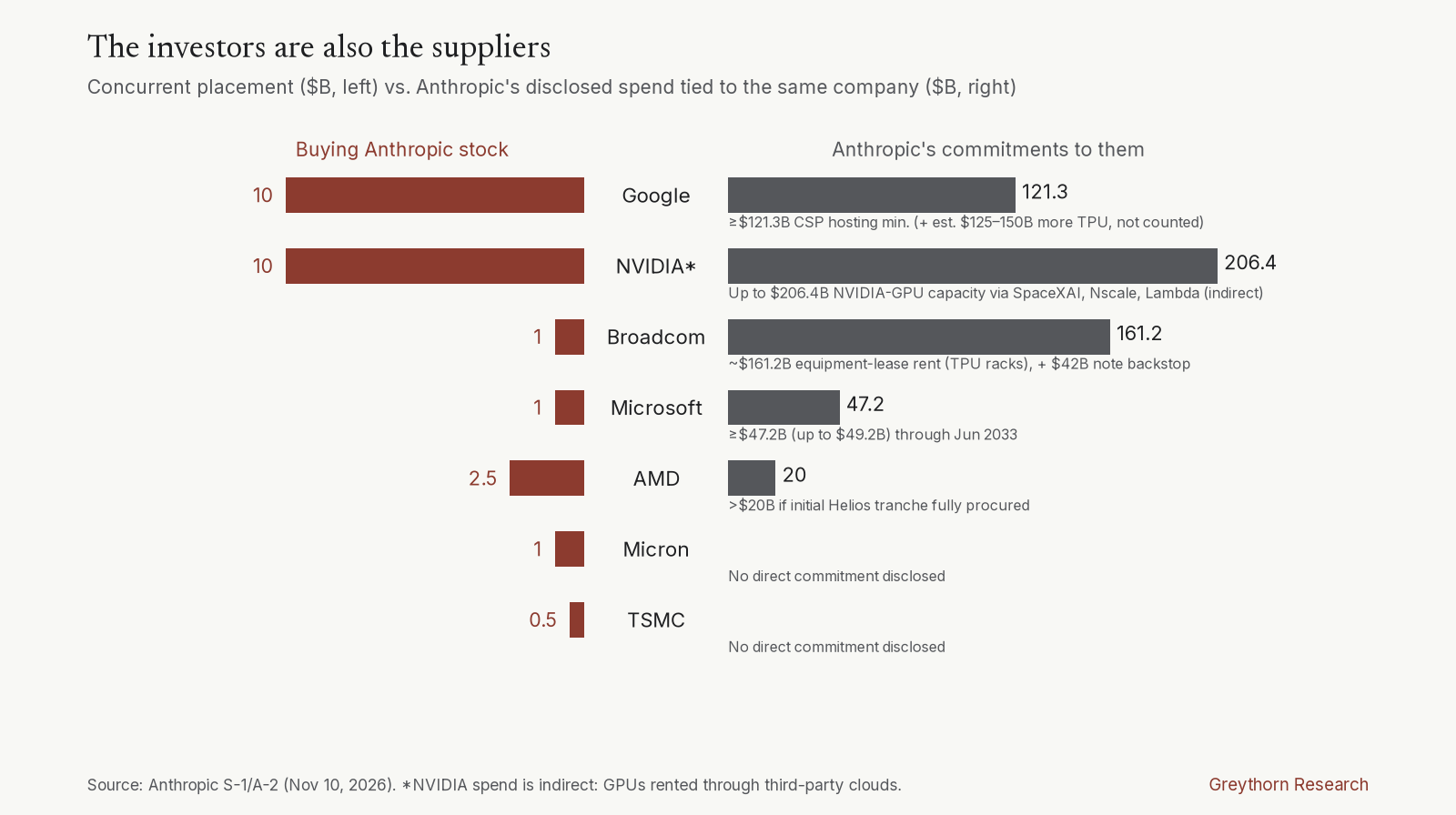
Source: Anthropic S-1/A-2. NVIDIA exposure is indirect (GPU capacity rented through SpaceXAI, Nscale and Lambda).
- Google is an investor (share issuances to it under the 2026 note agreement are capped at 14.99% ownership), Anthropic's largest hosting supplier, a distribution channel, and a named competitor. Its $10.0B placement is the exercise of an option under the March 2026 note agreement, "funding a portion of its previously committed investment obligations."
- AMD's $2.5B counts against a $5.0B equity commitment that is released as AMD GPUs are delivered and deployed. In plain terms, AMD's investment is tied to Anthropic buying AMD systems.
- Broadcom leases Anthropic the TPU hardware and can lend it up to $42.0B of convertible notes to pay that rent. The notes carry 9% interest paid in kind, rising to 13% if revenue conditions are missed. Broadcom has already assigned part of the lease to a special-purpose financing entity.
- NVIDIA invests $10B while Anthropic rents up to $206.4B of NVIDIA-GPU capacity through three neoclouds (our sum).
None of this is hidden; it is all in the filing. It does mean that revenue for the suppliers, equity for Anthropic and credit for the mid-layer now share one source of risk: Claude's usage growth.
The Mid-Layer: Who Actually Carries the Risk
Anthropic's NVIDIA capacity comes through intermediaries that must borrow to build it. The filing shows the strain:
- Nscale must use "best efforts to obtain qualifying financing."
- Lambda missed a deadline to secure a facility lease, so its $34.9B August contract "is currently terminable by either party." Neither side has given notice, and Anthropic says it does not intend to terminate (S-1/A-2).
CoreWeave shows how credit markets price this layer:
- Unsecured: its unsecured bonds have yielded nearly 16%.
- Contract-backed: it is marketing a $4B loan backed by Meta contracts at a target all-in rate of about 7.5%, syndicated by Morgan Stanley and MUFG (Semafor). The terms are not final and no 8-K has been filed.
- The March template: its $8.5B DDTL 4.0, also backed by a Meta contract, was rated A3 with a fixed tranche at about 5.9% and matures in March 2032 (CoreWeave). Moody's rated the ring-fenced deal, not the parent, which is Ba3 (Moody's).
- The gap: the new loan is about 160bp above the March fixed tranche. That is our calculation, and the structures differ.
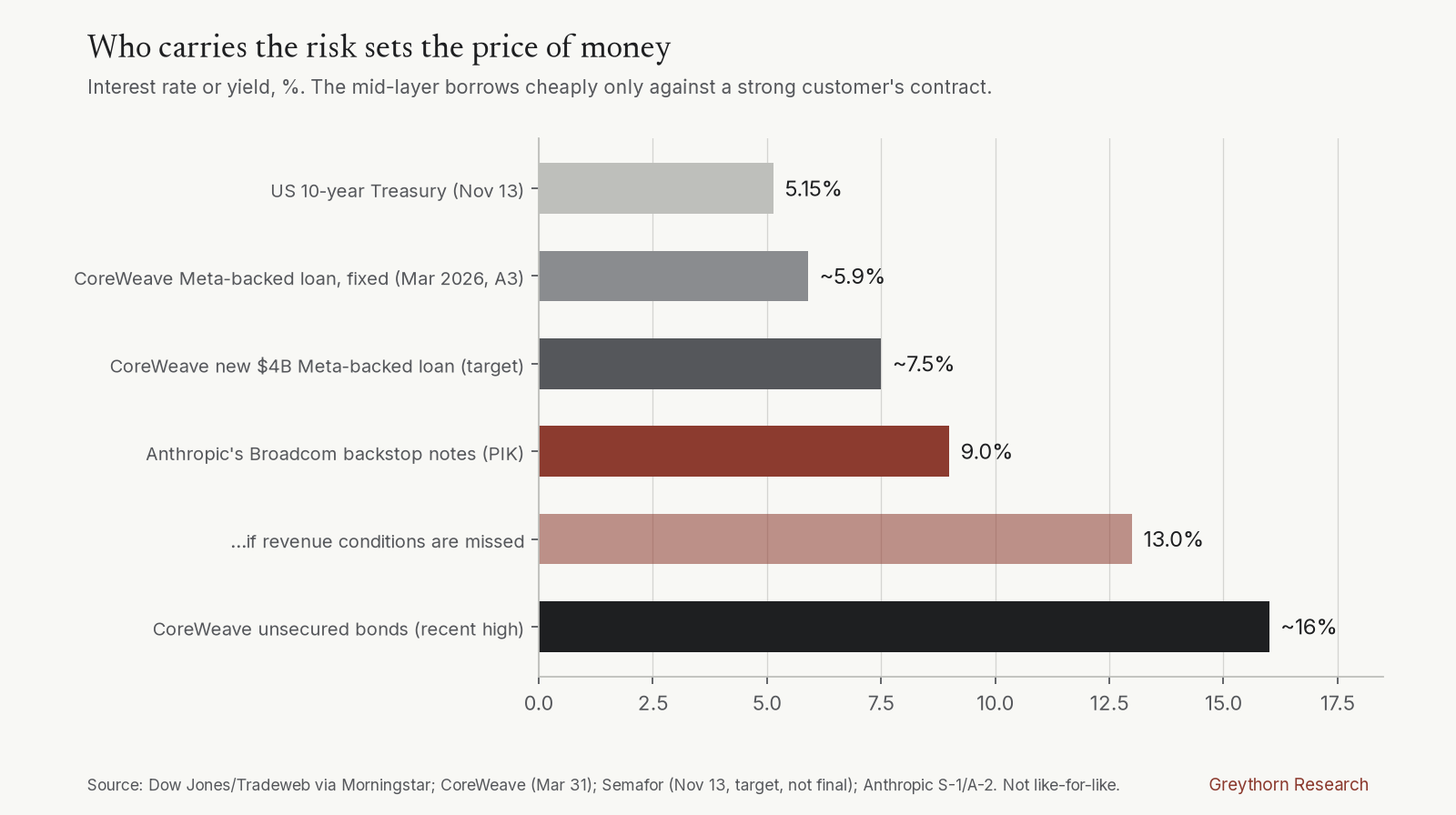
Source: Dow Jones/Tradeweb via Morningstar; CoreWeave (Mar 31); Semafor (Nov 13, target, not final); Anthropic S-1/A-2. Not like-for-like.
Our read: a neocloud borrows cheaply only against a customer the market trusts. Meta is rated AA, per Semafor. Anthropic's credit agreement has terms that apply only once it obtains investment-grade ratings from two of the three agencies, which suggests it does not have them today. Its own backstop paper from Broadcom costs 9–13%. In the chain, the lenders to the mid-layer carry construction and counterparty risk. Anthropic carries take-or-pay risk. Public shareholders sit beneath both. The IPO cash is what makes Anthropic financeable as a counterparty.
Valuation: What the Range Implies
| At IPO price | $70 | $74 | $78 |
|---|---|---|---|
| Shares outstanding per filing (B) | 13.11 | 13.09 | 13.07 |
| Market cap, filing basis | $917B | $968B | $1,019B |
| Fully diluted shares (B, Greythorn) | 18.10 | 18.08 | 18.06 |
| Fully diluted value | $1,267B | $1,338B | $1,409B |
| Pro forma cash & ST investments | ~$209B | $213B | ~$216B |
| EV (fully diluted − cash) | $1,058B | $1,125B | $1,193B |
| EV / TTM revenue ($35.3B) | 30.0x | 31.9x | 33.8x |
| EV / Q3 revenue × 4 ($67.8B) | 15.6x | 16.6x | 17.6x |
| EV / run-rate ($81B, non-GAAP) | 13.1x | 13.9x | 14.7x |
| EV / 2027E sell-side (~$136B, second-hand) | 7.8x | 8.3x | 8.8x |
Method (all Greythorn calculations from the S-1/A-2):
- Filing basis: 13,086,672,593 shares at $74, with Class N placement shares adjusted for price ($26.0B ÷ price).
- Fully diluted adds 1.774B options, 1.074B RSUs, 1.564B shares still issuable on Amazon's notes, 0.581B donation-matching shares and acquisition shares.
- Cash is $212.7B ± $0.793B per $1 of price. Finance leases ($1.95B) are excluded from EV. RSU tax-settlement effects are ignored.
- The 2027 estimate is a range of sell-side projections reported by Reuters (via CNBC TV18).
Our build reconciles both headlines. Reuters' "up to $1.02 trillion" is the filing-basis count at $78 (NBC/Reuters). CNBC's "$1.405 trillion" is fully diluted; we get $1.409T.
Against public names, using one method (value ÷ latest quarter's revenue × 4, Nov 11 closes), Trefis puts Anthropic at 18.6–20.7x. That compares with Palantir 44.8x, Snowflake 17.2x and NVIDIA 10.9x. Palantir earned a 47% operating margin in its quarter; Anthropic's Q3 GAAP operating margin was −3%.
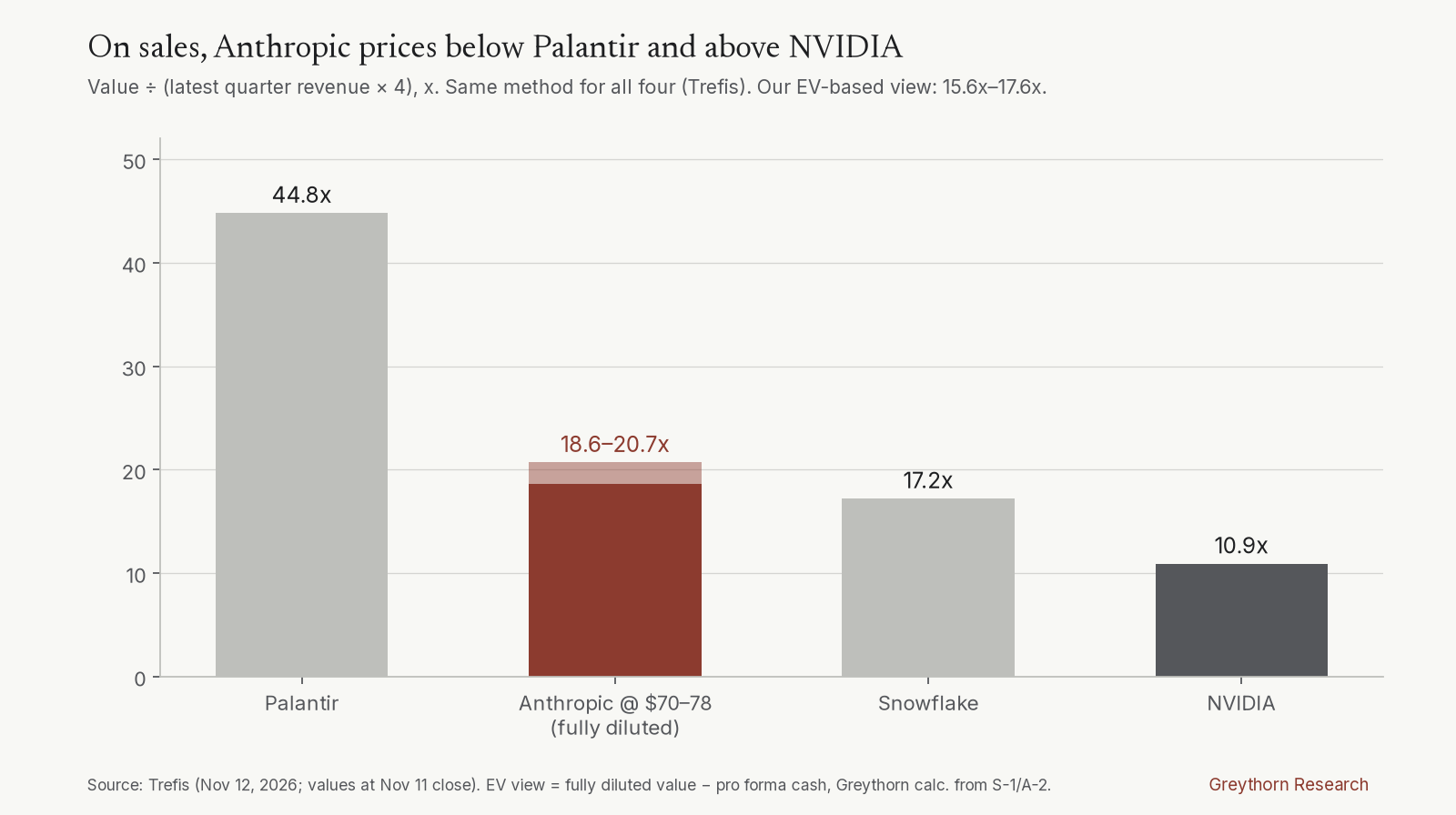
Source: Trefis (Nov 12, 2026; Nov 11 closes). EV-based view is a Greythorn calculation from the S-1/A-2.
What we cannot determine:
- The final price, size and allocation.
- Whether the $900.9B should be treated as debt-like. Leases not yet commenced do not appear in EV, but they are take-or-pay.
- Normalized compute margins once the short-term capacity rolls off.
- How much of the run-rate is durable. The filing calls the metric sensitive to seasonality and model launches.
- Banks' 2028 revenue projections (~$270–280B, per Reuters) are anonymous and unverified, so we do not use them.
Competition
The filing names Google and OpenAI as primary competitors, alongside open-weight models (S-1/A-2). Google is unusual: it is a competitor, a shareholder, Anthropic's largest hosting supplier and a sales channel all at once. Reuters reports that investors on the roadshow are asking whether Anthropic can hold its lead as Google catches up, and whether Claude can lead beyond coding. IPOX told Reuters there are no direct listed peers (IPOX). Price cuts of about $600M in Q3 show that competition already reaches revenue.
Risks
- Take-or-pay versus pay-as-you-go. Costs are contracted for years; revenue is mostly usage-based. The filing says: "In the past, we have significantly underestimated our compute requirements." The opposite error would be more expensive.
- Concentration. No customer exceeds 10% of revenue. The top five were about 25% of nine-month revenue, though their share fell to about 21% in Q3 from 36% in Q1 (our calculation from the filing's "79%" and "64%" figures outside the top five). CSP channels carry 44% of revenue.
- Counterparty and build risk. Lambda's $34.9B contract is terminable. Nscale depends on financing. SpaceXAI can cancel on 90 days' notice from early 2027.
- Supply of shares. The $26.0B placement is not locked up (though restricted). About 3.6B shares may become sellable before the 180-day lock-up ends, including up to 10% of employees' locked-up shares from the first trading day (S-1/A-2).
- Rates. A 5.15% 10-year raises the discount rate on cash flows that sit mostly after 2028. It also raises the mid-layer's borrowing cost.
- Governance. Holders of Class A shares cannot change control: Class F carries 50.1% of votes and the LTBT elects the board majority.
- Supplier turbulence. NVIDIA, a $10B buyer, is under an interim CEO.
Bull Case (steelmanned)
- Fastest scale-up in software history. Revenue went from $376M in Q1 2025 to $16.96B in Q3 2026, and ≥$100K customers grew 12x in a year. Morningstar's base-case fair value is $92, or $1.7T of equity, about 24% above the midpoint. Its bull case is $188 (Morningstar).
- Unit economics already turned. Compute fell from 251% to 48% of revenue in five quarters, nine-month cash flow is positive, and the Q3 dip has identifiable one-offs.
- The 12-month bill is covered three times over. Pro forma cash of ~$213B is three times the $70.7B due. The balance alone earned $1.25B of interest in Q3.
- Forward multiples look reasonable. On second-hand 2027 estimates the EV multiple is 8–9x. That is below NVIDIA's 10.9x trailing-quarter sales multiple (Trefis), for a company growing far faster.
- Suppliers buying stock is a signal, not a rescue. Partners who know the order books best are paying the IPO price, with no discount disclosed.
- Management is guiding conservatively. Buying "on the low side" and pricing below the $2T talk leaves room to beat.
Bear Case
- The price needs the ramp to work. At ~17.6x annualized Q3 revenue on EV, investors are paying today for 2028 revenue. Meanwhile ~$106B a year of commitments land before then. What would prove it wrong: compute below 50% of revenue for two quarters as committed capacity arrives.
- Circularity inflates the signal. Most placement dollars come from companies that will be paid many times over by Anthropic, and Google's portion was already committed. What would prove it wrong: large independent long-only allocations disclosed after pricing.
- Consumption revenue can reverse quickly. Usage-based revenue with 900% NRR can also contract fast, and price cuts are accelerating. What would prove it wrong: rising multi-year contracted revenue (RPO) in the first 10-Q.
- The mid-layer is fragile. If neoclouds cannot finance builds at ~7.5% without an AA customer behind them, Anthropic's GPU capacity arrives late or costs more in the short-term market, as Q3 showed. What would prove it wrong: Lambda's lease secured and Nscale financing closed.
- Morningstar's own bear case is $25, 66% below the midpoint.
What to Watch at Pricing (Nov 18 US ET, about Nov 19 morning SGT)
| Signal | Reassuring | Concerning |
|---|---|---|
| Final price | at or above $78, without upsizing the share count | below $70 or cut range |
| Filing | 424B4 with unchanged risk disclosure | S-1/A-3 adding material changes |
| Lambda $34.9B | lease secured | termination notice |
| CoreWeave $4B loan | prices near 7.5% | widens materially or stalls |
| First 10-Q (Q4) | compute < 55% of revenue | short-term compute repeats |
Correcting the Record
- "Anthropic IPO prices shares at $78" (Economic Times headline) is wrong. Its own body text describes a range, and EDGAR shows no pricing filing as of Nov 15.
- "Net up to $64.35 billion" (CNBC's wording) is the gross value of all 825M shares at $78, including $1.84B to selling holders. Anthropic's own new shares raise at most $62.5B gross. The company's net estimate, including the placement, is $84.6B at the midpoint (S-1/A-2).
- The Amodei quote is "deepest business dilemma" (Bloomberg Tax). Some summaries, including our own earlier notes, paraphrased it as "problem".
Closing Remarks
Anthropic is not a fragile company coming to market out of necessity. It has $131.8B of cash, positive operating cash flow and revenue compounding faster than any listed peer. The S-1/A-2 is also unusually candid. But this IPO is less a sale of a software business than the capitalization of a compute buyer. The investors, suppliers and lenders in the chain are all underwriting the same thing: that Claude's usage grows into a $900.9B bill.
At $70–78 the price does not discount that risk; it assumes it goes well. We would watch Q4 compute intensity, the fate of Lambda's contract and whether the mid-layer can still borrow at 7.5% once the rate backdrop is priced in. These matter more than the first-day pop.
Disclaimer: This article is for research and information-sharing only. It is not investment, financial, legal or tax advice, and it is not a recommendation to buy, sell or subscribe for any security, including in any initial public offering. Data come from the public sources linked and are as of the dates shown; they may change, and offering terms may change before pricing. Readers should read the prospectus, do their own research and form their own judgment.
Follow our research on X at @0xGreythorn and at greythorn.com.
Greythorn Research