Research · AI & compute
NVIDIA Is Now Financing Its Own Demand: $105B in Guarantees, $48B in Private Stakes, and What Nov 17 Must Show
Greythorn Research | Published Nov 9, 2026 (SGT) | Data as of NVIDIA's Q2 FY27 filings (quarter ended Jul 26, 2026) and the Nasdaq close of Nov 6, 2026
Key Insights
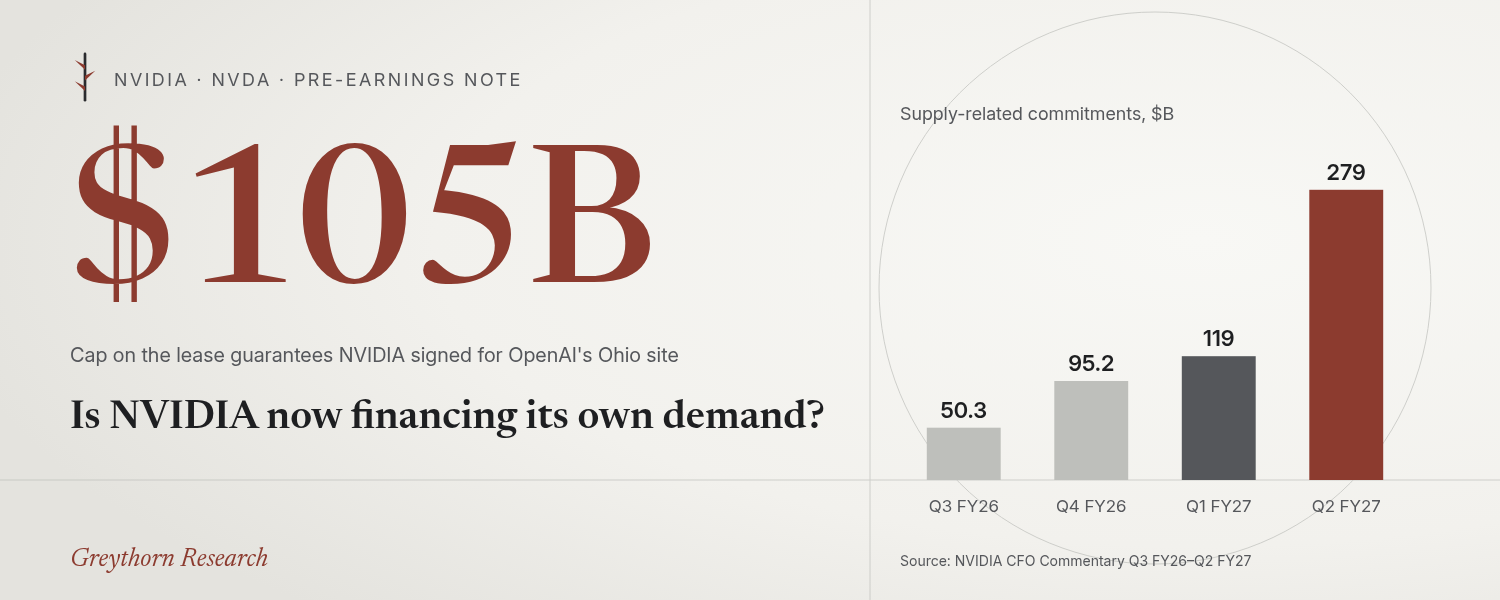
- NVIDIA's balance sheet now sits under part of its own demand. As of Jul 26, 2026 it reported $366B of its own commitments, $56B of commitments taken on for AI-cloud partners, and up to $108.5B of guarantees. The largest is a guarantee capped at $105B on the lease payments for OpenAI's 4.25 GW Ohio site.
- Supply commitments jumped from $119B to $279B in a single quarter. NVIDIA said the increase was "primarily related to the procurement of memory", locked in near what may be the top of a memory price cycle.
- Private equity stakes rose from $3.8B to $47.9B in a year. Equity-security gains were 22.8% of GAAP pre-tax income in Q1 FY27 and 10.9% in Q2. That is earnings from marking up private holdings, which, the CFO says, include roughly $50B in frontier AI labs that are also customers.
- Cash conversion fell. DSO reached 60 days on payment terms of up to one year, and operating cash flow was 40% of GAAP net income in Q2. NVIDIA also issued $25B of notes.
- Our view: this is not yet a solvency problem, because the guarantees are capped and phased in. It is a change in risk shape: revenue, receivables, equity value and guarantees are now concentrated in the same few borrowers. The Nov 17 print (US ET) can confirm or ease that.
Opening Remarks
For two years the NVIDIA debate was about demand. In its own words, demand is not the constraint: management guided to roughly 70% revenue growth in FY2028 and called it a "supply-constrained outlook" (Q2 FY27 earnings call transcript, NVIDIA IR).
The market has moved to a different question: who pays? NVDA closed at $186.64 on Nov 6, down 22.0% from its $239.24 close on Oct 6. That includes a −9.26% day on Nov 5 to $181.60 (Nasdaq historical), the session after Democratic midterm gains that brought calls for data-center restrictions (CNBC).
This piece reads NVIDIA's last three filings as a lender would. The question is not whether customers want GPUs, but how much of their ability to pay now rests on NVIDIA itself.
Background: Why a Chip Vendor Became a Financier
NVIDIA's CFO laid out the logic on the Q2 call. Frontier AI labs "are growing faster than what their balance sheets and credit profiles can support", and lack "the decades-long infrastructure contracts and investment-grade financing capacity" to secure capacity on their own (transcript). The company has responded in five ways:
- Equity. It has "invested nearly $50 billion in the frontier AI labs" (same transcript).
- Guarantees. It stands behind lease payments so that a lab can sign a 20-year lease it could not otherwise get.
- Payment terms. Some investment-grade buyers get "90 days up to one year" to pay (10-Q Q2 FY27, Note 7).
- Third-party capital. It announced partnerships with Apollo, BlackRock, Blackstone, Brookfield, Goldman Sachs and KKR to "mobilize over $500 billion", subject to definitive agreements (Q2 FY27 press release).
- Credit enhancement. "For another frontier AI lab, we will provide selective credit enhancement for nearly 2 gigawatts of compute" (transcript). The lab is not named.
The CFO addressed the critique head-on: "we know some will call this circular financing. We see it differently." She also said demand from the labs "for which we expect to leverage our balance sheet" should contribute "roughly a quarter of our business next year" (transcript).
The Mechanism, Line by Line
1. Guarantees: $108.5B maximum gross exposure.
- On Aug 17, 2026 NVIDIA entered residual value guaranties with SB Energy on leases for about 4.25 GW at the PORTS campus in Pike County, Ohio, with an OpenAI affiliate as tenant (8-K).
- How a payout works: if OpenAI becomes insolvent or misses payments, NVIDIA pays the shortfall between a guaranteed minimum lease value and whatever is recovered by re-letting or selling.
- Cap and timing: payments are capped at $105B. The guarantees phase in across nine construction phases, the first expected in FY2029, and decline over each 20-year lease (10-Q, Note 10).
- What NVIDIA gets: site exclusivity for NVIDIA hardware, a reimbursement and indemnity promise from OpenAI, and an option to back another ~3.8 GW.
- Earlier exposure: $3.5B of land, power and shell guarantees for AI-cloud partners, which those partners have partly offset with $712M in escrow (10-Q, Note 8).
- Accounting: the AI-cloud guarantees are carried as credit derivatives whose fair values were "not significant" (10-Q, Note 8). The $105B guarantee does not yet appear on the balance sheet as a liability of that size.
2. Commitments: $366B of its own, plus $56B for partners.
- NVIDIA said its commitments "increased from $119 billion last quarter to $279 billion, primarily related to the procurement of memory" (CFO commentary Q2 FY27).
- Adding cloud services, data-center leases, equity investments and capex brings the total to $366B.
- Separately, it signed $36B of AI-cloud agreements, under which it may share in the clouds' third-party revenue, and $20B of data-center leases it "expect[s] to reassign" to third parties (same source).
- On the same call, the CFO said memory price increases "exceeded our prior expectations", and guided gross margin to bottom at 71–72% in Q4 (transcript).
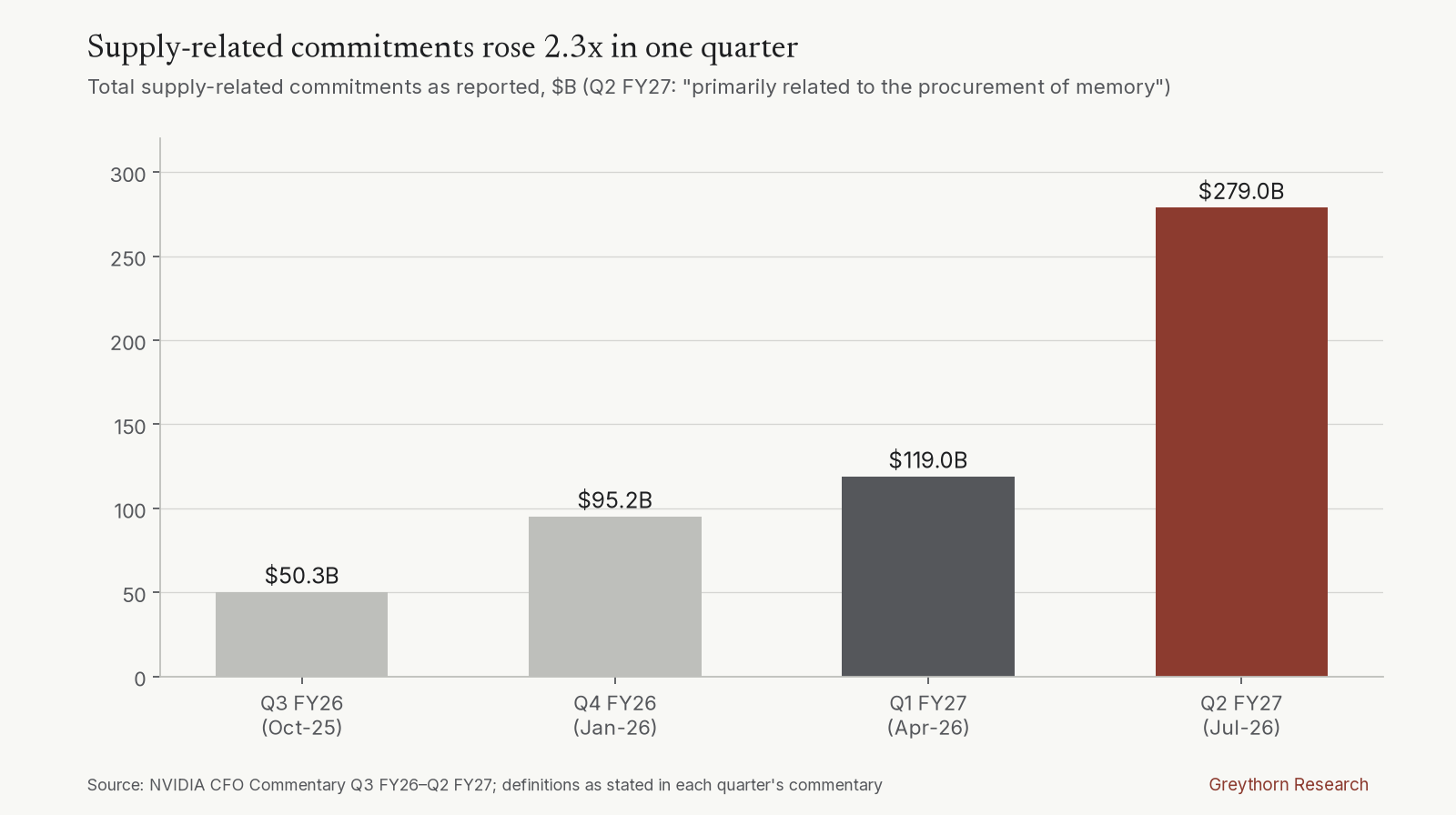
Source: NVIDIA CFO Commentary Q3 FY26–Q2 FY27 (supply-related commitments as stated each quarter: $50.3B, $95.2B, $119.0B, $279B)
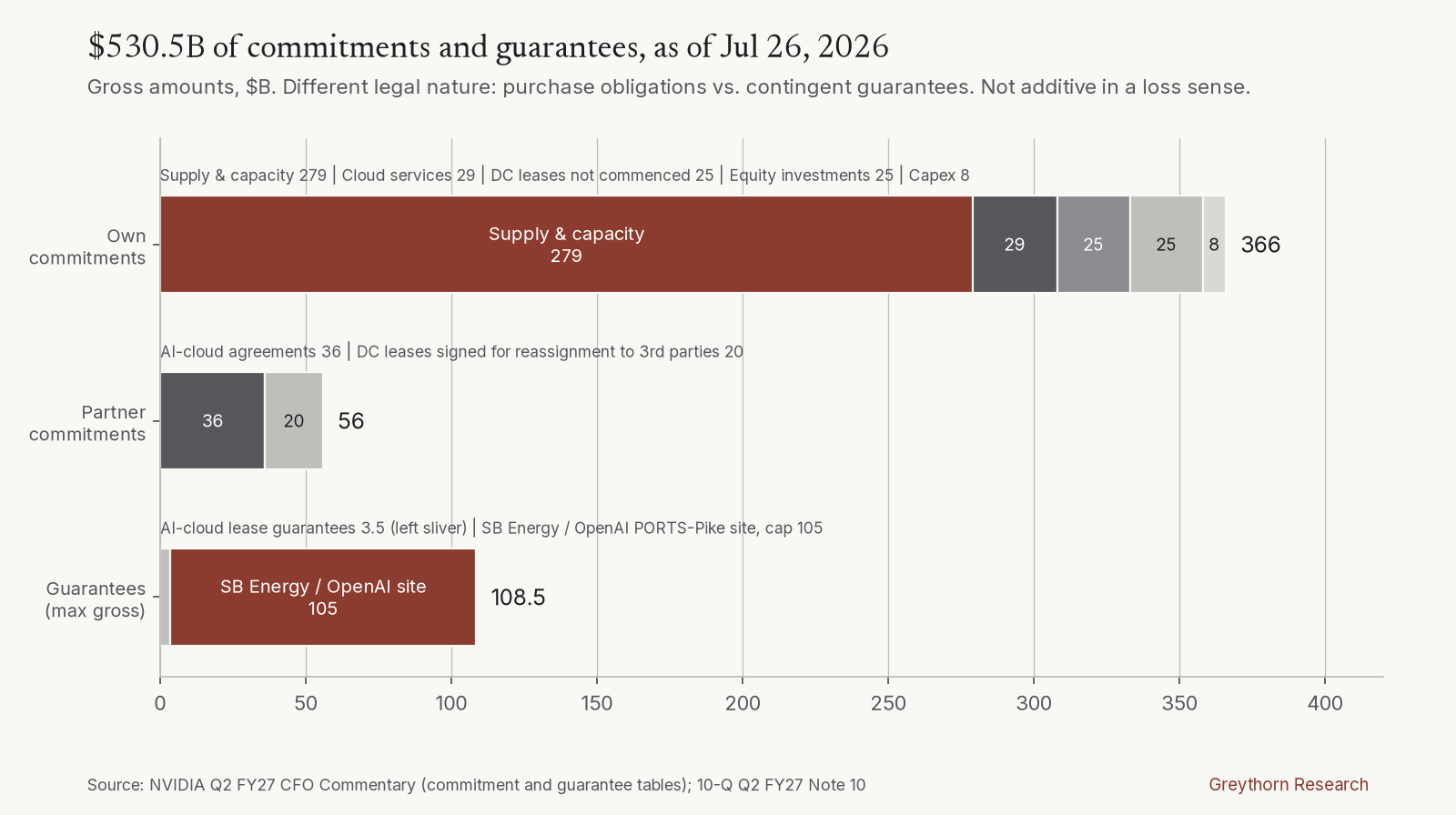
Source: NVIDIA Q2 FY27 CFO Commentary; 10-Q Q2 FY27 Note 10. Gross amounts; purchase obligations and contingent guarantees are different in nature.
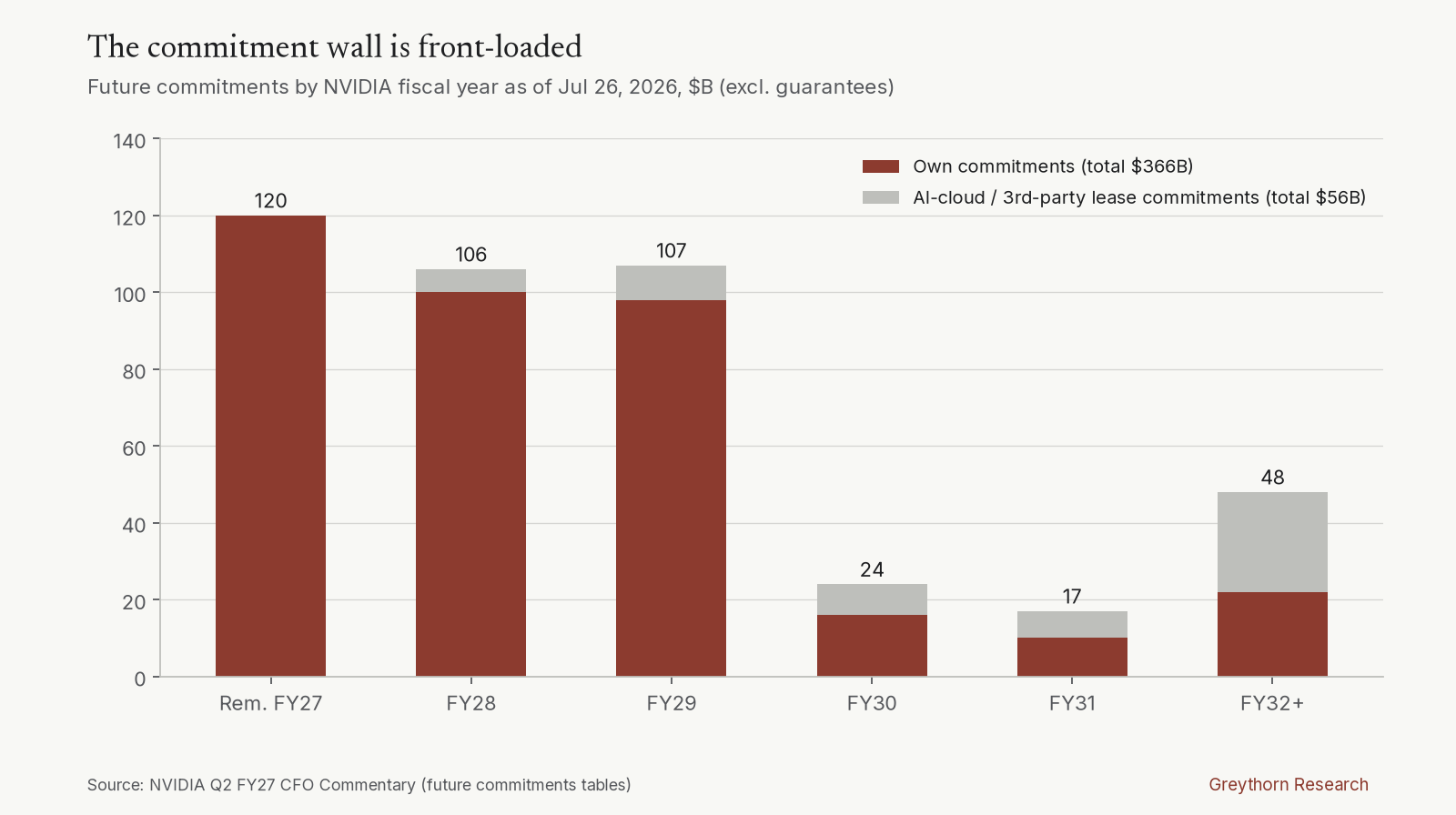
Source: NVIDIA Q2 FY27 CFO Commentary, future commitments by fiscal year. $120B falls in the rest of FY27, $106B in FY28, $107B in FY29.
3. Private stakes and GAAP gains.
- Non-marketable equity securities, which are holdings in private companies, grew from $3.8B (Jul 2025) to $8.2B (Oct 2025), $22.3B (Jan 2026), $42.3B (Apr 2026) and $47.9B (Jul 2026). Sources: 10-Q Q3 FY26 and 10-Q Q2 FY27, Note 6.
- These are valued at cost and "adjusted for observable price changes". When an investee raises a new round at a higher price, NVIDIA books a gain.
- Cumulative unrealized gains on these holdings stood at $9.1B.
- NVIDIA also holds $3.3B of equity-method stakes in "infrastructure financiers" and received warrants on publicly traded stock with a $4.8B notional value (10-Q, Notes 6 and 8).
- Net gains from equity securities were $15.9B in Q1 FY27 and $7.8B in Q2, according to the GAAP-to-non-GAAP reconciliations in the Q1 and Q2 CFO commentaries.
- Our calculation: those gains were 22.8% and 10.9% of GAAP pre-tax income. Non-GAAP figures exclude them; the GAAP headline does not.
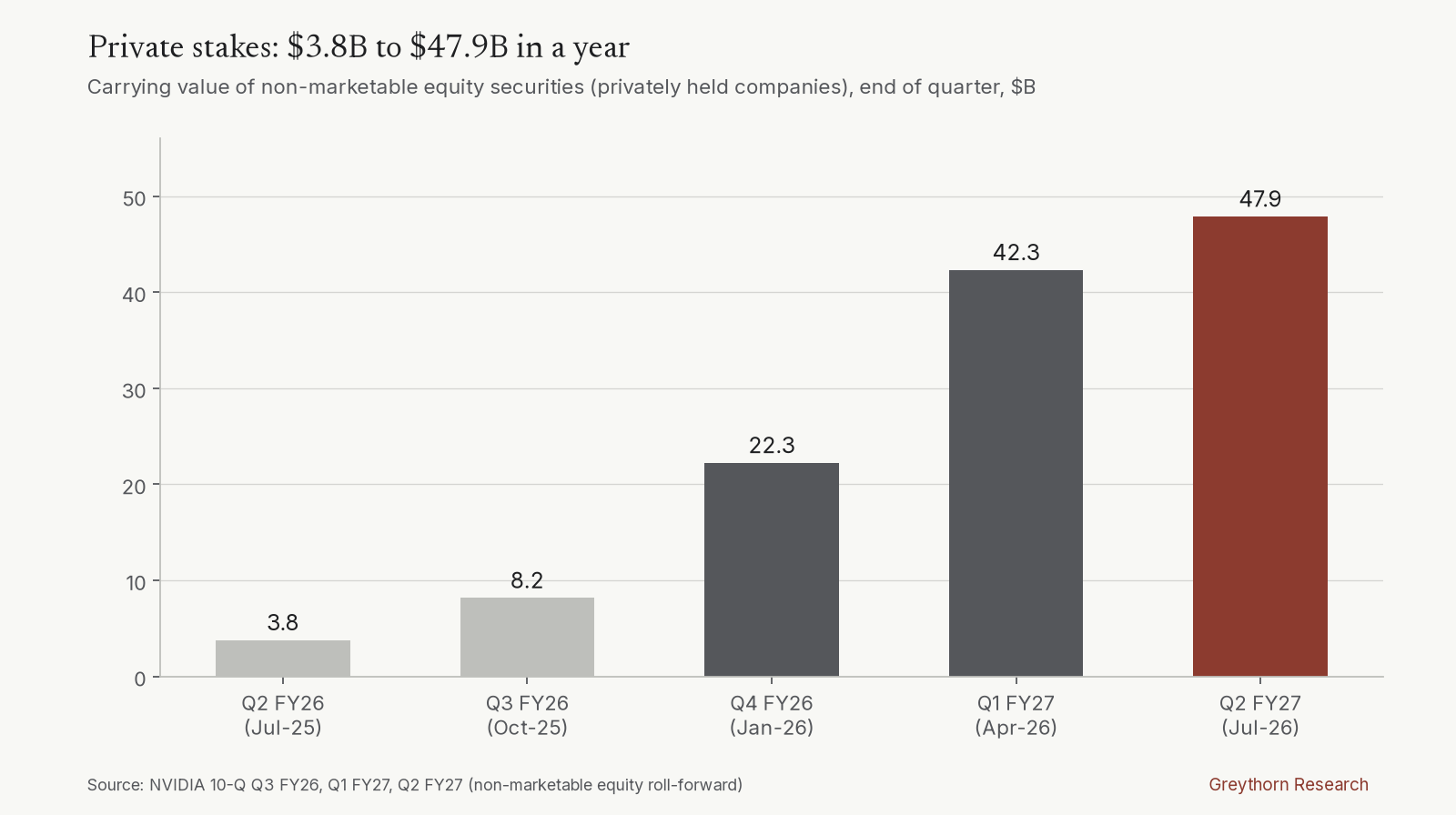
Source: NVIDIA 10-Q Q3 FY26, Q1 FY27, Q2 FY27 (non-marketable equity roll-forward)
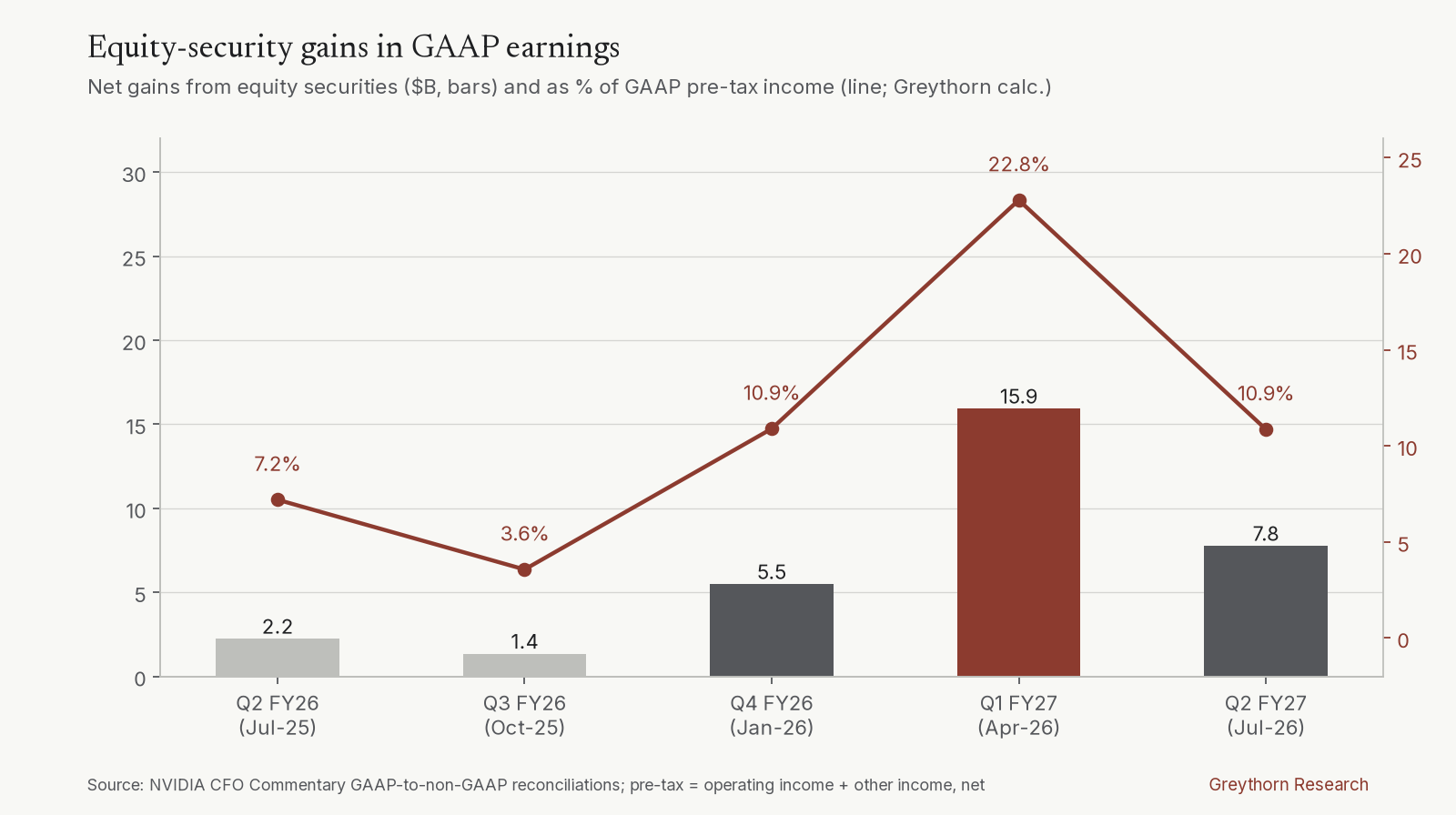
Source: NVIDIA CFO Commentary reconciliations, Q2 FY26–Q2 FY27; pre-tax income = operating income + other income, net (Greythorn calculation)
4. Receivables, cash and debt.
- Accounts receivable reached $63.1B at 60 days DSO, up from 45 days, "due to extended payment terms on large, multi-quarter agreements with certain investment-grade customers" (CFO commentary).
- In Q1, NVIDIA had said it expected DSO "to return to more normal levels next quarter" (Q1 CFO commentary). FY26 ran at 51–54 days.
- Operating cash flow fell to $24.1B from $50.3B. Part of that is seasonal, because Q1 commentary flagged "a substantial increase in cash taxes" for Q2.
- Five direct customers account for 70% of receivables (22/14/13/11/10%), and one direct customer was 16% of Q2 revenue (10-Q, Note 7 and MD&A).
- NVIDIA issued $25B of senior notes, taking the total to $33.5B outstanding. Cash and marketable debt securities were $56.6B.
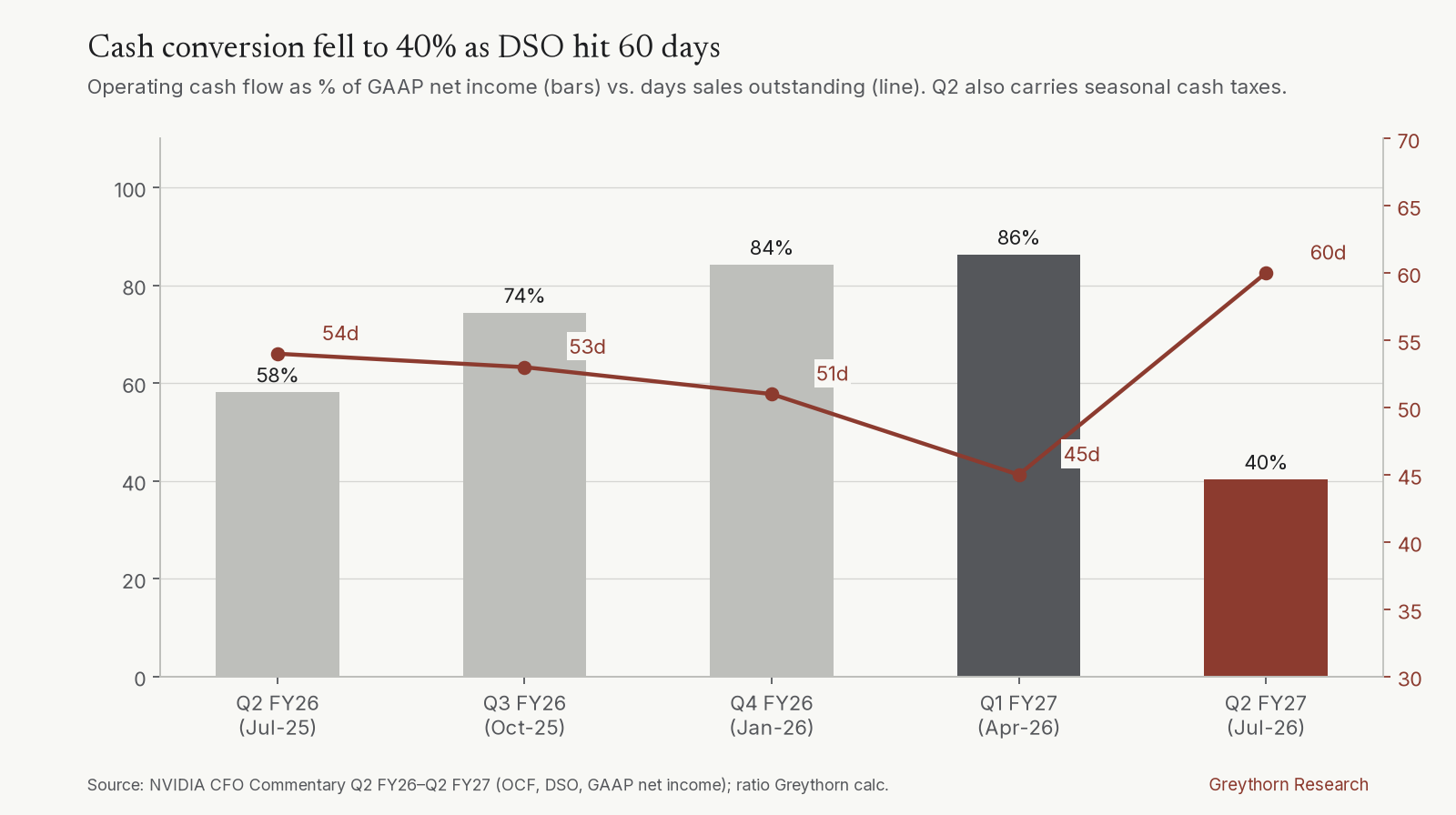
Source: NVIDIA CFO Commentary Q2 FY26–Q2 FY27 (operating cash flow, DSO, GAAP net income); ratio is a Greythorn calculation
Business Model and Financials
| Metric (US$) | Q2 FY26 | Q3 FY26 | Q4 FY26 | Q1 FY27 | Q2 FY27 |
|---|---|---|---|---|---|
| Revenue | 46.7B | 57.0B | 68.1B | 81.6B | 96.2B |
| GAAP net income | 26.4B | 31.9B | 43.0B | 58.3B | 59.7B |
| Equity-security gains | 2.2B | 1.4B | 5.5B | 15.9B | 7.8B |
| Operating cash flow | 15.4B | 23.8B | 36.2B | 50.3B | 24.1B |
| DSO (days) | 54 | 53 | 51 | 45 | 60 |
| Supply-related commitments | 45.8B* | 50.3B | 95.2B | 119.0B | 279B |
| Non-marketable equity | 3.8B | 8.2B | 22.3B | 42.3B | 47.9B |
Q2 FY26 is "total purchase commitments", a different definition. Sources: CFO Commentaries for Q2 FY26, Q3 FY26, Q4 FY26, Q1 FY27 and Q2 FY27, plus the 10-Qs cited above.
The core business remains extraordinary. Q2 revenue was up 106% year on year at a 75.0% gross margin, and first-half free cash flow was $69.9B. Q3 guidance is $108.0B ±2%, with a gross margin of 74.0% ±50bp and no China data-center compute assumed (press release).
Peers: Who Else Is Financing Demand?
This is not unique to NVIDIA, but the structures differ, so we compare form rather than multiples:
| Company | Structure | Source |
|---|---|---|
| NVIDIA | $105B lease guarantee (OpenAI site), ~$48B private stakes, extended payment terms, ~2 GW credit enhancement for an unnamed lab | 8-K, 10-Q, transcript above |
| NVIDIA → CoreWeave (2025) | $6.3B order to buy CoreWeave's unsold capacity through Apr 2032 | CoreWeave 8-K |
| Broadcom → Anthropic | Equipment lease to be assigned to a "designated financial partner", plus capacity for up to $42.0B of Anthropic convertible notes | Anthropic S-1 |
| Qualcomm → Amazon | Warrants covering up to $60B of Amazon purchases over 10 years, 15% vested immediately | Qualcomm Q4 FY26 presentation |
The difference is scale relative to the customer. NVIDIA's $108.5B guarantee cap equals about half of its FY26 revenue of $215.9B, and is roughly 1.9 times its $56.6B in cash and marketable debt securities (our calculation).
Risks
- Concentration. The same few counterparties appear as customers, investees, guarantee beneficiaries and receivable balances.
- Permitting and politics. NVIDIA's own 10-Q warns that "permitting delays, or community opposition may delay, restrict or prevent" data centers. After the midterms, Ohio's newly elected senator Sherrod Brown said "I do not work for data centers" (CNBC). The guaranteed site is in Ohio.
- Key-person and governance. On Nov 8 the board opened an independent investigation after reports that CEO Jensen Huang "has been the target of a foreign intelligence effort". It said it has "no reason to believe" national security or NVIDIA secrets were compromised, and that it has "confidence in Jensen" (NVIDIA Newsroom). Three House committee chairs have requested a closed-door briefing on Nov 18 (letter). The underlying espionage claims come from New York Times reporting and remain reported allegations. No charges have been announced.
- Memory cost. The $279B in commitments are fixed obligations while memory prices are elevated.
Bear Case (first)
- Correlated exposure. If a frontier lab stumbles, NVIDIA loses revenue, marks down equity, collects receivables later and may face guarantee calls, all at once. What would prove it wrong: disclosure showing guarantee and credit-enhancement exposure spread across many investment-grade counterparties, or OpenAI achieving the "satisfactory credit rating" that terminates the guarantee.
- Earnings quality. Up to 22.8% of quarterly GAAP pre-tax income came from marking up private stakes. Those stakes are valued on "observable price changes", meaning new funding rounds, and they include frontier AI labs that are also customers. What would prove it wrong: gains falling to low single digits of pre-tax income while GAAP growth holds.
- Cash conversion. Operating cash flow was 40% of net income in Q2, against 74–86% in the previous three quarters. What would prove it wrong: Q3 DSO back at or below ~54 days and operating cash flow at or above ~70% of net income.
- Commitment rigidity. $120B of commitments fall in the rest of FY27 and $106B in FY28. If demand slips, these become inventory, and NVIDIA already took $1.6B of inventory provisions in the first half. What would prove it wrong: commitments flattening while revenue keeps compounding.
- Opacity. The ~2 GW credit enhancement is neither sized nor named, and the filings show no liability of comparable size for the $105B guarantee, which is not yet effective. What would prove it wrong: a quantified disclosure in the Q3 10-Q.
- Site risk. Guarantees tied to specific sites import local permitting and power risk. What would prove it wrong: PORTS phases arriving on schedule.
Bull Case
- Capped and phased. Nothing is payable on the $105B before FY2029, the exposure declines as rent is paid, OpenAI must reimburse NVIDIA, and NVIDIA can re-let or sell the lease.
- Small against cash generation. First-half free cash flow was $69.9B, and the CFO described the ~$50B of lab investments as "a small fraction of our expected free cash flow".
- Redeployable collateral. Management calls the platform "fungible and durable".
- Demand outruns supply. Management guides to ~70% FY28 growth that is still supply-limited.
- Seasonality. Q2 operating cash flow carried a known cash-tax bump, and DSO swings with deal timing (51 → 45 → 60).
- Valuation already discounts risk (second-hand). TIKR data cited by Yahoo Finance puts NVDA's forward P/E at 15.43x on Nov 6, against a 5-year average of 35.86x (Yahoo/TIKR). We have not verified this against FactSet or Bloomberg.
What to Watch on Nov 17
The results come after the US close on Tuesday, Nov 17: release ~1:20pm PT, call 5pm ET, which is about 5:20am and 6:00am on Nov 18 in Singapore (NVIDIA IR).
| Line item | Q2 FY27 | What eases the bear case | What strengthens it |
|---|---|---|---|
| Revenue vs guide | guide $108.0B ±2% | ≥ $110.2B (top of range) | < $105.8B |
| Gross margin | guide 74.0% ±0.5 | ≥ 74% with Q4 guide ≥ 71% | below range |
| DSO | 60 days | ≤ 54 (FY26 range) | ≥ 60 again |
| OCF / GAAP net income | 40% | ≥ 70% | < 50% |
| Supply commitments | $279B | flat to modest rise | another step-up |
| Guarantees (max gross) | $108.5B | unchanged, plus sizing of ~2 GW | new guarantees |
| Equity gains / pre-tax income | 10.9% | < 5% | > 15% |
| Non-marketable equity | $47.9B | growth slows | another >$10B quarter |
| $500B financing platforms | "subject to definitive agreements" | signed, third-party funded | NVIDIA capital on top |
Consensus is second-hand: about $108.8B of revenue and $2.47 EPS per MarketBeat, as reported by eciks, and roughly $124B expected for the January-quarter guide per TIKR. A week earlier, CoreWeave reports Q3 after the US close on Nov 10 (CoreWeave IR). It is a useful read on how a financed customer is coping.
Closing Remarks
NVIDIA has not hidden any of this. The guarantees, stakes and payment terms are all in its filings, and the CFO named the "circular financing" critique herself. The issue is not disclosure. It is that the risk now sits in a different place.
A pure supplier sees a downturn in its order book. A supplier that also guarantees leases, holds equity in its customers and extends them credit sees the same downturn four times over. At around 15x forward earnings (second-hand), the market may already be pricing some of that. Nov 17 is the first chance to see whether cash conversion recovers and the commitment growth flattens, or whether both keep getting worse.
Disclaimer: This article is for research and information-sharing only. It is not investment, financial, legal or tax advice, and it is not a recommendation to buy or sell any security. Data come from the public sources linked and are as of the dates shown; they may change. Readers should do their own research and form their own judgment.
Follow our research on X at @0xGreythorn and at greythorn.com.
Greythorn Research